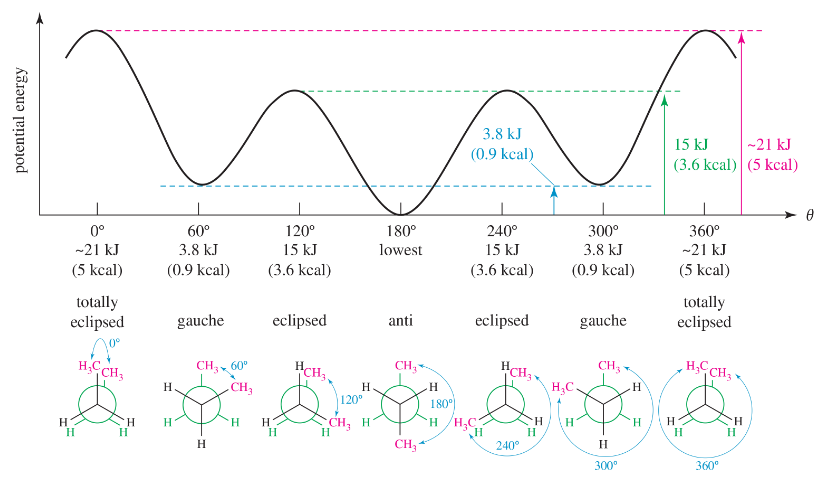
Draw a graph, similar to Figure 3-11, of the torsional energy of 2-methylbutane as it rotates about the C2—C3 bond.
Verified step by step guidance
1
Step 1: Understand the concept of torsional energy. Torsional energy arises due to the rotation around a bond, leading to different conformations with varying energy levels. In this case, the rotation is around the C2—C3 bond in 2-methylbutane.
Step 2: Analyze the provided graph (Figure 3-11). The graph shows the torsional energy changes as the molecule rotates around a bond, with specific conformations labeled (e.g., totally eclipsed, gauche, anti, etc.). The energy peaks correspond to eclipsed conformations, while valleys correspond to staggered conformations.
Step 3: Identify the key conformations for 2-methylbutane. Similar to the graph for butane, the conformations include totally eclipsed (highest energy), gauche (intermediate energy), anti (lowest energy), and eclipsed (higher energy but less than totally eclipsed). The substituents on the C2 and C3 carbons (CH3 and H groups) will influence the energy levels.
Step 4: Sketch the graph. Start by plotting the x-axis as the dihedral angle (θ) from 0° to 360° and the y-axis as the potential energy. Mark the energy peaks at 0° and 360° for the totally eclipsed conformation, intermediate peaks at 120° and 240° for eclipsed conformations, and valleys at 60° and 300° for gauche conformations, with the lowest valley at 180° for the anti conformation.
Step 5: Label the graph. Indicate the conformations (totally eclipsed, gauche, anti, eclipsed) at their respective angles and energy levels. Ensure the energy values are consistent with the substituent interactions in 2-methylbutane, similar to the pattern shown in Figure 3-11.
Verified video answer for a similar problem:
This video solution was recommended by our tutors as helpful for the problem above
Video duration:
8m
Play a video:
Was this helpful?
Key Concepts
Here are the essential concepts you must grasp in order to answer the question correctly.
Torsional Strain
Torsional strain arises from the repulsion between electron clouds in eclipsed conformations of a molecule. In the case of 2-methylbutane, as it rotates around the C2—C3 bond, the energy changes due to the varying degrees of overlap between the hydrogen atoms. This strain is a key factor in determining the stability of different conformations.
Conformational analysis involves studying the different spatial arrangements of a molecule that can be interconverted by rotation around single bonds. For 2-methylbutane, this analysis helps identify the most stable conformations (like anti and gauche) and the energy barriers between them, which are illustrated in the torsional energy graph.
A potential energy diagram visually represents the energy changes of a molecule as it undergoes conformational changes. In the case of 2-methylbutane, the graph shows energy minima and maxima corresponding to different conformations, allowing for a clear understanding of the stability and energy costs associated with each conformation during rotation about the C2—C3 bond.