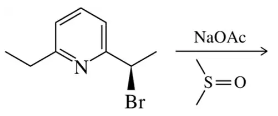
Would you expect the following conditions to favor SN1 or SN2? (b)
Verified step by step guidance
1
Analyze the substrate: The substrate contains a bromine atom attached to a secondary carbon, which is adjacent to a pyridine ring. The pyridine ring is an electron-withdrawing group, which can stabilize a carbocation intermediate, favoring SN1 reactions.
Consider the nucleophile: Sodium acetate (NaOAc) is a weak nucleophile. Weak nucleophiles typically favor SN1 mechanisms because they do not strongly attack the substrate, allowing the carbocation intermediate to form.
Evaluate the solvent: The solvent appears to be dimethyl sulfoxide (DMSO), which is a polar aprotic solvent. Polar aprotic solvents generally favor SN2 mechanisms because they stabilize the nucleophile without stabilizing the carbocation. However, the substrate and nucleophile characteristics may override this solvent preference.
Assess steric hindrance: The secondary carbon attached to bromine is moderately hindered, which can make SN2 reactions less favorable due to steric hindrance. This steric hindrance supports the likelihood of an SN1 mechanism.
Combine all factors: The electron-withdrawing pyridine ring stabilizes the carbocation, the weak nucleophile favors SN1, and the steric hindrance disfavors SN2. While the polar aprotic solvent typically favors SN2, the other factors suggest that SN1 is the more likely mechanism under these conditions.
Verified video answer for a similar problem:
This video solution was recommended by our tutors as helpful for the problem above
Play a video:
0 Comments
Key Concepts
Here are the essential concepts you must grasp in order to answer the question correctly.
Sₙ1 Mechanism
The Sₙ1 mechanism, or unimolecular nucleophilic substitution, involves a two-step process where the leaving group departs first, forming a carbocation intermediate. This mechanism is favored in polar protic solvents and with tertiary substrates due to the stability of the carbocation. The rate of reaction depends only on the concentration of the substrate, making it a first-order reaction.
The Sₙ2 mechanism, or bimolecular nucleophilic substitution, occurs in a single concerted step where the nucleophile attacks the substrate as the leaving group departs. This mechanism is favored by strong nucleophiles and occurs in polar aprotic solvents. The reaction rate depends on both the substrate and nucleophile concentrations, making it a second-order reaction.
Several factors influence whether a reaction will proceed via Sₙ1 or Sₙ2 mechanisms, including substrate structure (primary, secondary, or tertiary), the strength of the nucleophile, solvent type, and steric hindrance. Tertiary substrates and polar protic solvents favor Sₙ1, while primary substrates and strong nucleophiles in polar aprotic solvents favor Sₙ2. Understanding these factors is crucial for predicting reaction pathways.

 Verified step by step guidance
 04:32
04:32