Join thousands of students who trust us to help them ace their exams!Watch the first video
Multiple Choice
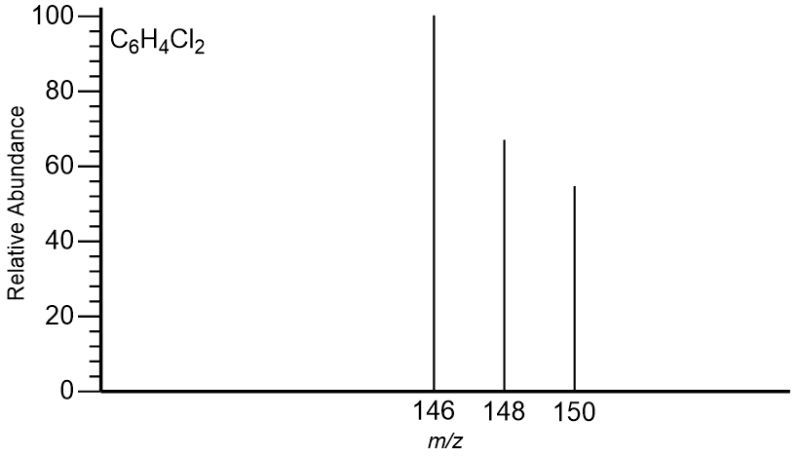
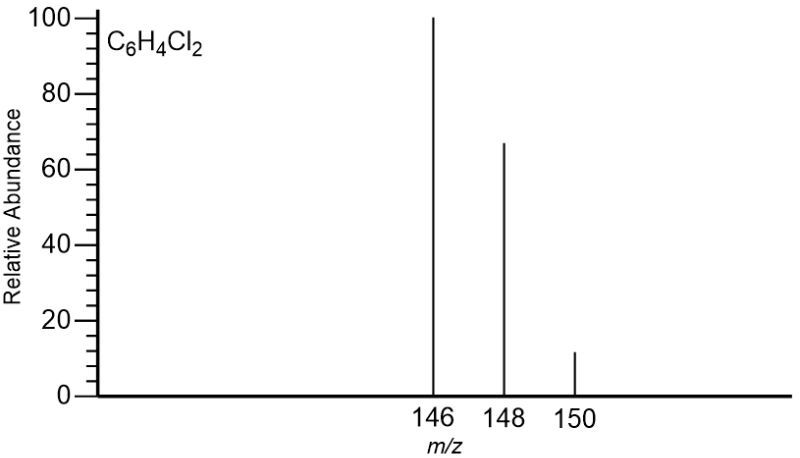
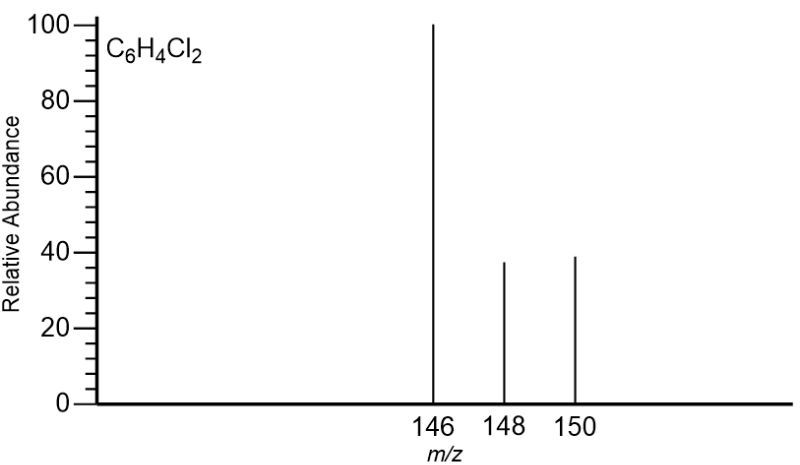
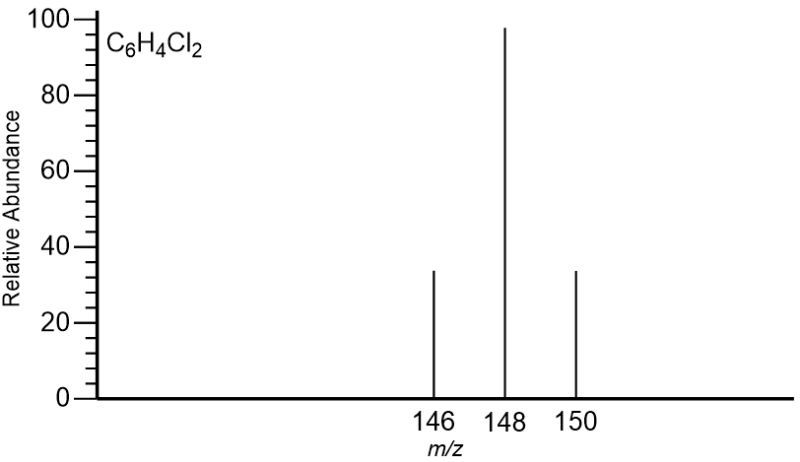
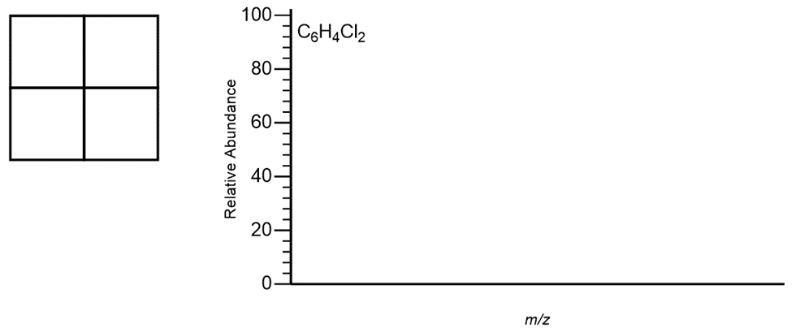
1,4-dichlorobenzene is used as an insecticide and has the formula C6H4Cl2. What would be the approximate relative heights of M, M+2, and M+4 peaks. For simplicity assume that all carbon atoms are 12C and the 35Cl:37Cl ratio is 75:25.
A
B
C
D
0 Comments
Verified step by step guidance
1
Identify the molecular ion peak (M) for 1,4-dichlorobenzene (C6H4Cl2) in the mass spectrum. The M peak corresponds to the molecular weight of the compound, which is 146 (since all carbon atoms are 12C and the chlorine is 35Cl).
Determine the M+2 peak, which results from the presence of one 37Cl isotope instead of 35Cl. The M+2 peak will be at m/z 148.
Determine the M+4 peak, which results from the presence of two 37Cl isotopes. The M+4 peak will be at m/z 150.
Calculate the relative intensities of the M, M+2, and M+4 peaks using the natural abundance of chlorine isotopes. The ratio of 35Cl to 37Cl is 75:25. Therefore, the probability of having two 35Cl atoms is (0.75 * 0.75), one 35Cl and one 37Cl is 2 * (0.75 * 0.25), and two 37Cl atoms is (0.25 * 0.25).
Express the relative intensities of the peaks as a ratio based on the calculated probabilities: M (0.75 * 0.75), M+2 (2 * 0.75 * 0.25), and M+4 (0.25 * 0.25).



 Verified step by step guidance

 Problem sets built by lead tutors