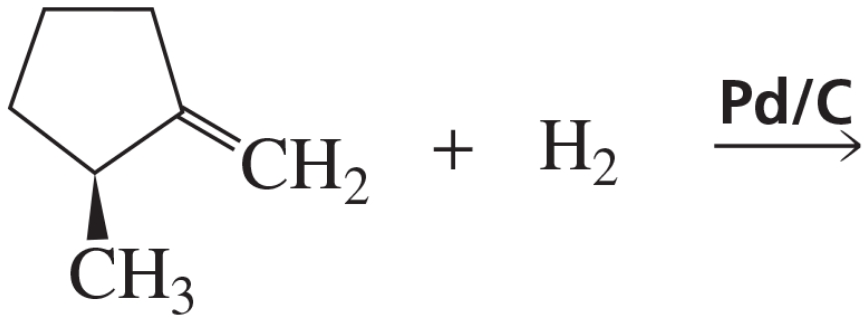
a. What stereoisomers are formed in the following reaction? Are they enantiomers or diastereomers? b. Which stereoisomer is formed in greater yield?
Verified step by step guidance
1
Step 1: Analyze the reaction conditions. The reaction involves hydrogenation using Pd/C as a catalyst. This is a typical catalytic hydrogenation reaction where the double bond in the alkene is reduced to a single bond by the addition of hydrogen.
Step 2: Identify the stereochemical implications of the reaction. Hydrogenation typically occurs on the same face of the molecule (syn addition), leading to the formation of stereoisomers. The stereochemistry of the product depends on the approach of hydrogen to the double bond.
Step 3: Determine the stereoisomers formed. The reduction of the double bond creates two new stereocenters. The possible stereoisomers are the cis and trans configurations of the product. These stereoisomers are diastereomers because they are not mirror images of each other.
Step 4: Predict the major product. In catalytic hydrogenation, steric hindrance plays a role in determining the major product. The hydrogen atoms are added to the less hindered face of the molecule, leading to the formation of the stereoisomer with the substituents in the least sterically hindered positions.
Step 5: Conclude the stereochemical outcome. The major stereoisomer formed will be the one where the bulky groups (CH3 and the cyclopentane ring) are positioned to minimize steric interactions. This stereoisomer will be formed in greater yield compared to the other diastereomer.
Verified video answer for a similar problem:
This video solution was recommended by our tutors as helpful for the problem above
Video duration:
4m
Play a video:
0 Comments
Key Concepts
Here are the essential concepts you must grasp in order to answer the question correctly.
Stereoisomers
Stereoisomers are compounds that have the same molecular formula and connectivity of atoms but differ in the spatial arrangement of their atoms. This category includes enantiomers, which are non-superimposable mirror images, and diastereomers, which are not mirror images of each other. Understanding the types of stereoisomers is crucial for analyzing reactions that produce different spatial configurations.
Enantiomers are pairs of stereoisomers that are mirror images of each other, typically having identical physical properties except for their interaction with polarized light. Diastereomers, on the other hand, are stereoisomers that are not mirror images and often have different physical properties. Distinguishing between these two types is essential for predicting the behavior of the products in a chemical reaction.
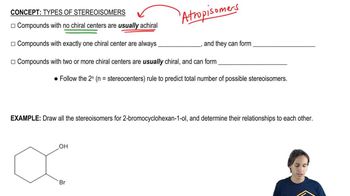
Using chiral centers to predict types of stereoisomers.
Yield of Stereoisomers
The yield of stereoisomers refers to the relative amounts of each stereoisomer produced in a chemical reaction. Factors such as reaction conditions, steric hindrance, and the stability of intermediates can influence which stereoisomer is formed in greater yield. Understanding these factors is important for predicting the outcome of reactions involving stereochemistry.