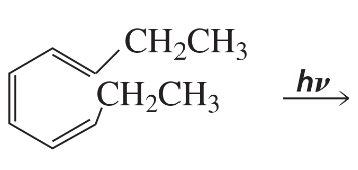
Draw the product of each of the following reactions: c. d.
Verified step by step guidance
1
Step 1: Analyze the given reaction conditions. The presence of 'hv' indicates that the reaction is photochemical, which often involves radical formation and rearrangements.
Step 2: Identify the structure of the starting material. The molecule is a benzene ring with two ethyl groups attached at the ortho positions. The double bonds in the benzene ring are conjugated, and the ethyl groups are susceptible to radical reactions under photochemical conditions.
Step 3: Consider the mechanism of the reaction. Photochemical reactions can lead to homolytic cleavage of bonds, generating radicals. In this case, the ethyl groups may undergo hydrogen abstraction or bond rearrangement to form new products.
Step 4: Predict the possible products. The reaction may lead to the formation of a cyclized product or rearranged structure due to radical recombination or stabilization. The benzene ring may remain intact, but the substituents could change.
Step 5: Draw the product based on the expected mechanism. Ensure that the product adheres to the rules of organic chemistry, such as maintaining aromaticity in the benzene ring and stabilizing any radicals formed during the reaction.
Verified video answer for a similar problem:
This video solution was recommended by our tutors as helpful for the problem above
Video duration:
8m
Play a video:
0 Comments
Key Concepts
Here are the essential concepts you must grasp in order to answer the question correctly.
Reaction Mechanisms
Understanding reaction mechanisms is crucial in organic chemistry as they describe the step-by-step process by which reactants transform into products. This includes identifying intermediates, transition states, and the movement of electrons. Familiarity with mechanisms helps predict the outcome of reactions and the stability of products formed.
Functional groups are specific groups of atoms within molecules that are responsible for the characteristic chemical reactions of those molecules. Recognizing functional groups is essential for predicting reactivity and understanding how different compounds will interact in a reaction. Common functional groups include alcohols, carboxylic acids, and amines.
Stereochemistry involves the study of the spatial arrangement of atoms in molecules and how this affects their chemical behavior. It is important for understanding isomerism, where compounds with the same molecular formula can have different structures and properties. Stereochemical considerations are vital when drawing reaction products, especially in reactions that form chiral centers.

 8:26 minutes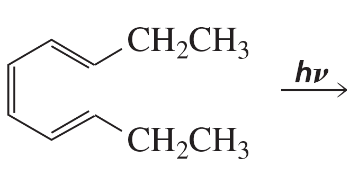
 Verified step by step guidance
 02:16
02:16