How many signals would you expect to see in the 1H NMR spectrum of each of the five compounds with molecular formula C6H14?
Verified step by step guidance
1
Step 1: Understand the molecular formula C6H14. This is an alkane with six carbon atoms and 14 hydrogen atoms, meaning it is a saturated hydrocarbon. The compounds with this formula are structural isomers.
Step 2: Identify the five possible isomers of C6H14. These are: n-hexane, 2-methylpentane, 3-methylpentane, 2,2-dimethylbutane, and 2,3-dimethylbutane. Each isomer has a unique structure, which affects the number of unique hydrogen environments.
Step 3: Analyze the symmetry of each isomer to determine the number of unique hydrogen environments. Hydrogens in identical chemical environments will produce the same signal in the 1H NMR spectrum.
Step 4: For each isomer, count the unique hydrogen environments. For example, in n-hexane, all six carbons are in a straight chain, and the hydrogens on equivalent carbons will produce the same signal. In contrast, branched isomers like 2-methylpentane will have more unique environments due to reduced symmetry.
Step 5: Summarize the number of signals for each isomer. For example, n-hexane will have fewer signals compared to 2,2-dimethylbutane, which has more branching and thus more unique hydrogen environments. This step involves systematically analyzing each isomer's structure to determine the number of signals.
Verified video answer for a similar problem:
This video solution was recommended by our tutors as helpful for the problem above
Video duration:
6m
Play a video:
0 Comments
Key Concepts
Here are the essential concepts you must grasp in order to answer the question correctly.
Nuclear Magnetic Resonance (NMR) Spectroscopy
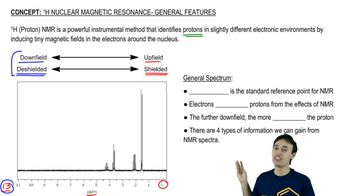
NMR spectroscopy is a powerful analytical technique used to determine the structure of organic compounds. It relies on the magnetic properties of certain nuclei, such as hydrogen-1 (1H), to provide information about the number and environment of hydrogen atoms in a molecule. The resulting spectrum displays signals that correspond to different hydrogen environments, allowing chemists to infer structural details.
The chemical environment refers to the specific surroundings of a hydrogen atom within a molecule, which can influence its magnetic resonance signal. Factors such as electronegativity of nearby atoms, hybridization, and molecular symmetry affect the chemical shift observed in the NMR spectrum. Identifying unique environments helps predict the number of distinct signals in the spectrum.
Chemical Reactions of Phosphate Anhydrides Concept 1
Isomerism
Isomerism is the phenomenon where compounds share the same molecular formula but differ in structure or spatial arrangement. For the molecular formula C6H14, various structural isomers exist, such as straight-chain and branched alkanes. Each isomer can produce a different number of NMR signals due to variations in hydrogen environments, making it essential to consider isomerism when analyzing NMR data.

 6:03 minutes
 Verified step by step guidance
 10:06
10:06