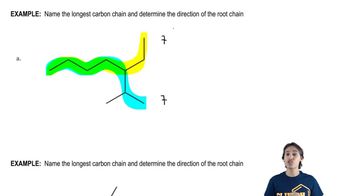
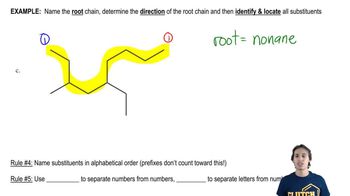
The following names are all incorrect or incomplete, but they represent real structures. Draw each structure and name it correctly. a. 2-ethylpentane b. 3-isopropylhexane
Verified step by step guidance
1
Step 1: Understand the structure implied by the name '2-ethylpentane'. The name suggests a pentane chain with an ethyl group attached to the second carbon. However, this name is incorrect because adding an ethyl group to a pentane chain at the second position would result in a longer chain, not a pentane.
Step 2: Draw the structure for '2-ethylpentane'. Start with a five-carbon chain (pentane) and attempt to add an ethyl group to the second carbon. You will notice that this creates a seven-carbon chain, which should be named as heptane.
Step 3: Correct the name for '2-ethylpentane'. Since the longest chain is now seven carbons, the correct name should be '3-methylheptane', where the ethyl group is actually a methyl group on the third carbon of the heptane chain.
Step 4: Understand the structure implied by the name '3-isopropylhexane'. The name suggests a hexane chain with an isopropyl group attached to the third carbon. However, this name is incorrect because adding an isopropyl group to a hexane chain at the third position would result in a longer chain, not a hexane.
Step 5: Correct the name for '3-isopropylhexane'. Draw the structure starting with a six-carbon chain (hexane) and attempt to add an isopropyl group to the third carbon. You will notice that this creates a seven-carbon chain, which should be named as '4-methylheptane', where the isopropyl group is actually a methyl group on the fourth carbon of the heptane chain.
Verified video answer for a similar problem:
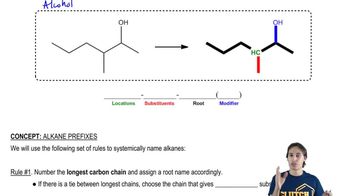
This video solution was recommended by our tutors as helpful for the problem above
Video duration:
3m
Play a video:
Was this helpful?
Key Concepts
Here are the essential concepts you must grasp in order to answer the question correctly.
IUPAC Nomenclature
IUPAC nomenclature is a standardized system for naming chemical compounds. It ensures that each compound has a unique name based on its structure, using rules for identifying the longest carbon chain, numbering the chain, and naming substituents. Understanding these rules is crucial for correctly naming organic molecules.
In organic chemistry, identifying the longest continuous carbon chain is essential for naming compounds. This chain serves as the base name of the molecule, and substituents are named and numbered based on their position relative to this chain. Misidentifying the longest chain can lead to incorrect naming.
Substituents are groups attached to the main carbon chain, and their correct identification and positioning are vital for accurate nomenclature. The position is indicated by the lowest possible numbers, and common substituents like ethyl, methyl, and isopropyl have specific naming conventions. Properly naming and numbering these groups ensures clarity and correctness in chemical communication.