The dehydrogenation of butane to trans-but-2-ene has ΔH° = +116 kJ/mol (+27.6 kcal/mol) and ΔS° = +117J/kelvin-mol (+28.0 cal/kelvin-mol). a. Compute the value of ΔG° for dehydrogenation at room temperature (25 °C or 298 °K). Is dehydrogenation favored or disfavored?HINT: When you are doing synthesis problems, avoid using these high-temperature industrial methods. They require specialized equipment, and they produce variable mixtures of products.
Verified step by step guidance
1
Identify the given values: ΔH° = +116 kJ/mol and ΔS° = +117 J/K·mol. Convert ΔS° to kJ by dividing by 1000, resulting in ΔS° = +0.117 kJ/K·mol.
Use the Gibbs free energy equation: ΔG° = ΔH° - TΔS°, where T is the temperature in Kelvin.
Substitute the given values into the equation: ΔG° = 116 kJ/mol - (298 K)(0.117 kJ/K·mol).
Calculate the value of TΔS°: (298 K)(0.117 kJ/K·mol).
Subtract the value of TΔS° from ΔH° to find ΔG°. Determine if the reaction is favored by checking if ΔG° is negative (favored) or positive (disfavored).
Verified video answer for a similar problem:
This video solution was recommended by our tutors as helpful for the problem above
Video duration:
6m
Play a video:
0 Comments
Key Concepts
Here are the essential concepts you must grasp in order to answer the question correctly.
Gibbs Free Energy (ΔG°)
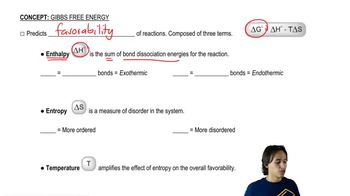
Gibbs Free Energy (ΔG°) is a thermodynamic potential that indicates the spontaneity of a reaction at constant temperature and pressure. It is calculated using the equation ΔG° = ΔH° - TΔS°, where ΔH° is the change in enthalpy, T is the temperature in Kelvin, and ΔS° is the change in entropy. A negative ΔG° value suggests that the reaction is spontaneous, while a positive value indicates non-spontaneity.
Breaking down the different terms of the Gibbs Free Energy equation.
Enthalpy (ΔH°)
Enthalpy (ΔH°) is a measure of the total heat content of a system and reflects the energy required to break and form bonds during a chemical reaction. In the context of the dehydrogenation of butane, a positive ΔH° value (+116 kJ/mol) indicates that the reaction is endothermic, meaning it absorbs heat from the surroundings. This factor can influence the spontaneity of the reaction when combined with entropy changes.
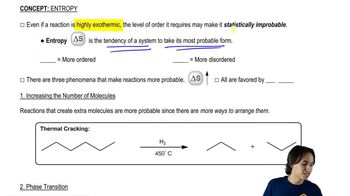
Entropy (ΔS°) is a measure of the disorder or randomness in a system. A positive ΔS° value (+117 J/K·mol) suggests that the products of the reaction have greater disorder compared to the reactants. In thermodynamics, an increase in entropy generally favors spontaneity, as systems tend to evolve towards states of higher disorder. The interplay between ΔH° and ΔS° is crucial for determining the overall spontaneity of a reaction.

 6:04 minutes
 Verified step by step guidance
 05:02
05:02