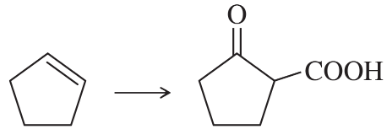
Show how you would accomplish the following syntheses in good yields. (h)
Verified step by step guidance
1
Step 1: Begin with cyclopentene as the starting material. Perform an oxidation reaction to convert the alkene into a diol. This can be achieved using reagents such as osmium tetroxide (OsO₄) followed by hydrogen peroxide (H₂O₂) or potassium permanganate (KMnO₄) under mild conditions.
Step 2: Subject the diol to oxidative cleavage to break the carbon-carbon double bond and form two carbonyl groups. Use a reagent like periodic acid (HIO₄) or ozone (O₃) followed by dimethyl sulfide (DMS) for ozonolysis.
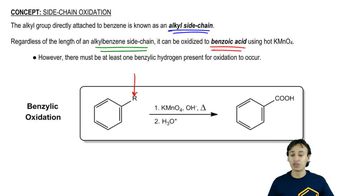
Step 3: After cleavage, one of the resulting carbonyl groups will be an aldehyde. Oxidize the aldehyde to a carboxylic acid using a strong oxidizing agent such as potassium permanganate (KMnO₄) or chromium-based reagents like Jones reagent (CrO₃/H₂SO₄).
Step 4: Ensure the ketone group remains intact during the oxidation process. This selective oxidation will yield the desired product, 2-oxocyclopentanecarboxylic acid.
Step 5: Purify the product using techniques such as recrystallization or distillation to obtain the compound in good yield.
Verified video answer for a similar problem:
This video solution was recommended by our tutors as helpful for the problem above
Video duration:
5m
Play a video:
0 Comments
Key Concepts
Here are the essential concepts you must grasp in order to answer the question correctly.
Electrophilic Addition Reactions
Electrophilic addition reactions are fundamental in organic chemistry, particularly for alkenes and cycloalkenes. In these reactions, an electrophile reacts with a nucleophile, leading to the formation of a more complex molecule. For the synthesis of carboxylic acids from cyclopentene, understanding how electrophiles add to the double bond is crucial for predicting the products.
Oxidation reactions involve the increase of oxidation state of a molecule, often through the addition of oxygen or the removal of hydrogen. In the context of converting cyclopentene to a carboxylic acid, oxidation is key, as it transforms the alkene into a carbonyl group and subsequently into a carboxylic acid. Recognizing the reagents and conditions that facilitate these transformations is essential for successful synthesis.
Functional group interconversion refers to the process of transforming one functional group into another, which is a common strategy in organic synthesis. In this case, converting an alkene to a carboxylic acid involves multiple steps, including the formation of an intermediate carbonyl compound. Mastery of these transformations allows chemists to design efficient synthetic pathways to desired products.