How do the major products obtained from rearrangement of the following arene oxides differ?
Verified step by step guidance
1
Step 1: Analyze the given arene oxides. The structures provided are two arene oxides with isotopic labels (H and D) on the hydroxyl group and adjacent carbon. These isotopic labels will influence the rearrangement products due to their positions.
Step 2: Understand the rearrangement mechanism. Arene oxides typically undergo rearrangement via a NIH shift, where the substituent (hydrogen or deuterium) migrates to the adjacent carbon during the formation of phenols.
Step 3: Predict the migration pattern. In the first structure, the hydrogen (H) is positioned on the carbon adjacent to the oxygen, while deuterium (D) is on the hydroxyl group. During rearrangement, the hydrogen is likely to migrate to the oxygen-bearing carbon. In the second structure, the positions of H and D are reversed, so the deuterium will migrate instead.
Step 4: Consider the stereochemical implications. The migration of H or D will result in phenols with different isotopic labeling patterns. The major products will differ based on which isotope (H or D) migrates during the rearrangement.
Step 5: Conclude the difference in products. The major products obtained from the rearrangement of the two arene oxides will differ in the placement of isotopic labels (H and D) on the phenol ring, reflecting the migration patterns during the NIH shift.
Verified video answer for a similar problem:
This video solution was recommended by our tutors as helpful for the problem above
Video duration:
6m
Play a video:
0 Comments
Key Concepts
Here are the essential concepts you must grasp in order to answer the question correctly.
Arene Oxides
Arene oxides are reactive intermediates formed from the oxidation of aromatic compounds. They typically contain an epoxide structure, where an oxygen atom is incorporated into the aromatic ring. Understanding their formation and reactivity is crucial, as they can undergo various rearrangements leading to different products, depending on the substituents on the aromatic ring and the reaction conditions.
Rearrangement reactions involve the structural reorganization of a molecule to form a different isomer. In the context of arene oxides, these reactions can lead to the formation of different products through mechanisms such as migration of substituents or ring opening. The specific pathways taken during rearrangement can significantly influence the nature and distribution of the final products.
Product distribution refers to the relative amounts of different products formed in a chemical reaction. In the case of arene oxide rearrangements, factors such as sterics, electronics, and the stability of intermediates play a critical role in determining which products are favored. Analyzing product distribution helps chemists understand the underlying mechanisms and predict the outcomes of similar reactions.

 6:02 minutes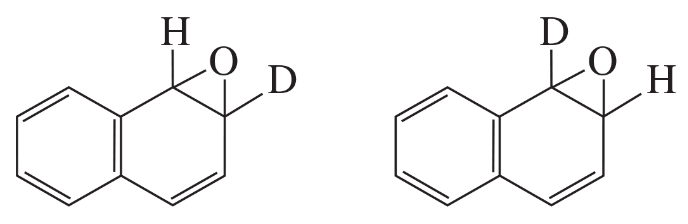
 Verified step by step guidance
 03:40
03:40