Draw a condensed structure for each of the following: i. diethylacetylene j. di-tert-butylacetylene
Verified step by step guidance
1
Step 1: Understand the structure of acetylene. Acetylene is the simplest alkyne with the formula C₂H₂, containing a triple bond between two carbon atoms.
Step 2: For diethylacetylene, identify the substituents. 'Diethyl' indicates two ethyl groups (-CH₂CH₃) attached to the acetylene backbone. Place one ethyl group on each carbon of the triple bond.
Step 3: Draw the condensed structure for diethylacetylene. Represent the ethyl groups as CH₃CH₂ and connect them to the carbons of the triple bond. The condensed structure will look like CH₃CH₂-C≡C-CH₂CH₃.
Step 4: For di-tert-butylacetylene, identify the substituents. 'Di-tert-butyl' indicates two tert-butyl groups ((CH₃)₃C-) attached to the acetylene backbone. Place one tert-butyl group on each carbon of the triple bond.
Step 5: Draw the condensed structure for di-tert-butylacetylene. Represent the tert-butyl groups as (CH₃)₃C and connect them to the carbons of the triple bond. The condensed structure will look like (CH₃)₃C-C≡C-C(CH₃)₃.
Verified video answer for a similar problem:
This video solution was recommended by our tutors as helpful for the problem above
Video duration:
8m
Play a video:
0 Comments
Key Concepts
Here are the essential concepts you must grasp in order to answer the question correctly.
Condensed Structural Formula
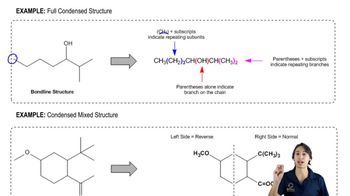
A condensed structural formula is a way of representing a chemical compound that shows the arrangement of atoms and the connectivity between them without depicting all the bonds explicitly. In this format, groups of atoms are often grouped together to simplify the structure, making it easier to visualize larger molecules. For example, in a condensed formula, 'C2H5' represents an ethyl group, indicating two carbon atoms and five hydrogen atoms.
Alkynes are a class of hydrocarbons characterized by at least one carbon-carbon triple bond. They follow the general formula CnH2n-2, where 'n' is the number of carbon atoms. The presence of the triple bond gives alkynes unique chemical properties, including increased reactivity compared to alkenes and alkanes. Understanding the structure and reactivity of alkynes is essential for drawing their condensed formulas accurately.
Tertiary alkyl groups are carbon groups where the central carbon atom is bonded to three other carbon atoms. This structure significantly influences the stability and reactivity of the compound. In the context of di-tert-butylacetylene, the presence of two tert-butyl groups (C4H9) attached to the acetylene backbone affects the overall molecular structure and properties, making it crucial to recognize these groups when drawing condensed structures.

 8:24 minutes
 Verified step by step guidance
 06:06
06:06