Of the possible products shown for the following reaction, are there any that will not be formed?
Verified step by step guidance
1
Step 1: Analyze the given reactants and reaction conditions. The reactants are 1-bromo-2-propene (CH3-CH=CH2-Br) and HCl. This reaction involves electrophilic addition of HCl to the double bond in the alkene.
Step 2: Recall Markovnikov's rule, which states that in the addition of HX (where X is a halogen) to an alkene, the hydrogen atom will add to the carbon with more hydrogen atoms already attached, and the halogen will add to the carbon with fewer hydrogen atoms.
Step 3: Identify the possible carbocation intermediates. When HCl adds to the double bond, the proton (H⁺) can add to either the terminal carbon (CH2) or the middle carbon (CH) of the double bond, forming two possible carbocations: a primary carbocation (less stable) or a secondary carbocation (more stable). The secondary carbocation is favored due to its greater stability.
Step 4: Predict the major product based on the favored carbocation intermediate. The Cl⁻ ion will attack the more stable secondary carbocation, leading to the formation of the Markovnikov product. The anti-Markovnikov product is unlikely under these conditions unless a peroxide is present, which is not indicated here.
Step 5: Evaluate the given products. The product where Cl is attached to the terminal carbon (anti-Markovnikov product) will not be formed under these conditions. The other products shown are consistent with Markovnikov addition and are plausible.
Verified video answer for a similar problem:
This video solution was recommended by our tutors as helpful for the problem above
Video duration:
4m
Play a video:
0 Comments
Key Concepts
Here are the essential concepts you must grasp in order to answer the question correctly.
Reaction Mechanisms
Understanding reaction mechanisms is crucial in organic chemistry as they describe the step-by-step process by which reactants transform into products. This includes identifying intermediates, transition states, and the role of catalysts. By analyzing the mechanism, one can predict which products are likely to form and which are not based on the stability of intermediates and the energy barriers involved.
Regioselectivity refers to the preference of a chemical reaction to yield one structural isomer over others when multiple products are possible. This concept is essential for predicting the outcome of reactions, especially in cases where functional groups can react at different positions on a molecule. Understanding regioselectivity helps in determining which products will be favored based on the stability of the resulting isomers.
Stereochemistry involves the study of the spatial arrangement of atoms in molecules and how this affects their chemical behavior. In reactions that can produce stereoisomers, it is important to consider factors such as chirality and stereoselectivity. Recognizing how stereochemical factors influence product formation is key to understanding which products may or may not be formed in a given reaction.

 4:21 minutes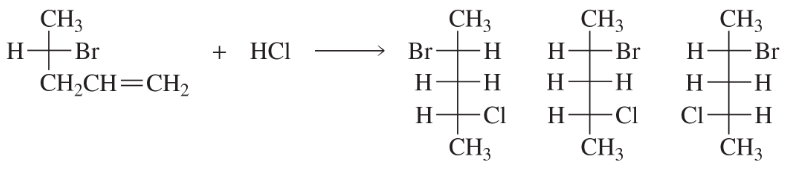
 Verified step by step guidance
 02:16
02:16