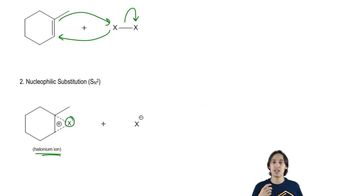
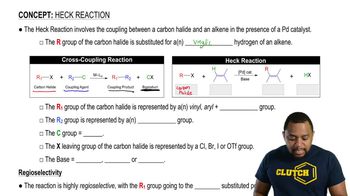
What is the major product of each of the following reactions, assuming that one equivalent of each reagent is used in each reaction? b.
Verified step by step guidance
1
Analyze the structure of the starting compound: The molecule contains both a terminal alkyne (≡C) and a terminal alkene (C=C). These functional groups are reactive toward bromine (Br₂).
Understand the reaction mechanism: Bromine reacts with alkenes and alkynes via electrophilic addition. For one equivalent of Br₂, the reaction will preferentially occur at the more reactive site, which is typically the alkene due to its higher electron density compared to the alkyne.
Predict the product at the alkene: The addition of Br₂ to the alkene will result in the formation of a vicinal dibromide (two bromine atoms added across the double bond). The stereochemistry of the addition is anti, meaning the bromine atoms will add to opposite sides of the double bond.
Consider the alkyne: Since only one equivalent of Br₂ is used, the alkyne remains unreacted in this case. The alkyne is less reactive than the alkene under these conditions.
Combine the results: The major product will have the alkene converted into a vicinal dibromide, while the alkyne remains intact. The structure of the product will reflect this selective reactivity.
Verified video answer for a similar problem:
This video solution was recommended by our tutors as helpful for the problem above
Video duration:
6m
Play a video:
0 Comments
Key Concepts
Here are the essential concepts you must grasp in order to answer the question correctly.
Alkynes and Their Reactivity
Alkynes are hydrocarbons that contain at least one carbon-carbon triple bond. They are generally more reactive than alkenes due to the presence of this triple bond, which can undergo various reactions, including halogenation. In halogenation, alkynes react with halogens (like Br2) to form dihaloalkenes or tetrahaloalkanes, depending on the conditions and the number of equivalents of halogen used.
The halogenation of alkynes typically proceeds through an electrophilic addition mechanism. Initially, the triple bond acts as a nucleophile, attacking a halogen molecule, leading to the formation of a cyclic halonium ion intermediate. This intermediate is then attacked by a halide ion, resulting in the formation of a vicinal dibromide product. Understanding this mechanism is crucial for predicting the major product of the reaction.
Regioselectivity refers to the preference of a chemical reaction to yield one structural isomer over others when multiple products are possible. In the case of halogenation of alkynes, the regioselectivity can be influenced by the structure of the alkyne and the conditions of the reaction. For example, terminal alkynes may lead to different products compared to internal alkynes, affecting the final product distribution.