Predict the products of reaction of pent-1-yne with the following reagents. g. cold, dilute KMnO4 h. warm, concd. KMnO4, NaOH i. Na, liquid ammonia
Verified step by step guidance
1
Step 1: Understand the structure of pent-1-yne. It is a terminal alkyne with the molecular formula C5H8, where the triple bond is located between the first and second carbon atoms.
Step 2: For reaction (g) with cold, dilute KMnO4, recognize that this reagent performs mild oxidation. It adds hydroxyl groups (-OH) across the triple bond, resulting in a diol. Specifically, the triple bond will be converted into a cis-diol (two hydroxyl groups on adjacent carbons).
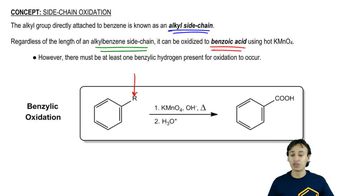
Step 3: For reaction (h) with warm, concentrated KMnO4 in the presence of NaOH, understand that this is a strong oxidative cleavage reaction. The triple bond will be completely broken, and the alkyne will be oxidized to carboxylic acids. Since pent-1-yne is a terminal alkyne, one product will be a carboxylic acid (R-COOH), and the other will be carbon dioxide (CO2).
Step 4: For reaction (i) with sodium (Na) in liquid ammonia, recognize that this is a reduction reaction. Sodium in liquid ammonia reduces alkynes to trans-alkenes. The triple bond in pent-1-yne will be reduced to a trans-alkene, specifically trans-pent-2-ene.
Step 5: Summarize the products for each reaction: (g) cis-diol from mild oxidation, (h) carboxylic acid and CO2 from oxidative cleavage, and (i) trans-alkene from reduction. Ensure you understand the role of each reagent and the type of reaction it facilitates.
Verified video answer for a similar problem:
This video solution was recommended by our tutors as helpful for the problem above
Video duration:
9m
Play a video:
0 Comments
Key Concepts
Here are the essential concepts you must grasp in order to answer the question correctly.
Alkyne Reactivity
Alkynes, such as pent-1-yne, are hydrocarbons with a carbon-carbon triple bond. Their reactivity is influenced by the presence of this triple bond, which can undergo various reactions, including addition and oxidation. Understanding how alkynes react with different reagents is crucial for predicting the products of these reactions.
Oxidation reactions involve the addition of oxygen or the removal of hydrogen from a molecule. In the context of alkynes, reagents like cold, dilute KMnO4 (Bayer's reagent) can lead to syn-dihydroxylation, while warm, concentrated KMnO4 can oxidatively cleave the triple bond, resulting in carboxylic acids. Recognizing the type of oxidation and its conditions is essential for predicting the products.
Reduction reactions involve the gain of electrons or hydrogen, often resulting in the conversion of a triple bond to a double or single bond. The reaction of pent-1-yne with sodium in liquid ammonia is a classic example of a reduction that can yield a trans-alkene. Understanding the mechanisms of reduction helps in predicting the structural outcomes of such reactions.