Predict the products and propose mechanisms for the following reactions. (c)
Verified step by step guidance
1
Step 1: Analyze the given structure. The molecule is a cyclic ketone with two hydroxyl groups attached to the ring. The reaction conditions include acidic medium (H3O+) and heat (Δ), which suggests a dehydration reaction or rearrangement might occur.
Step 2: Recognize the functional groups and reaction type. The hydroxyl groups (-OH) are prone to protonation under acidic conditions, leading to the formation of good leaving groups (water). This sets the stage for elimination reactions.
Step 3: Protonation of one of the hydroxyl groups occurs first. The acidic medium donates a proton (H+) to one of the hydroxyl groups, converting it into a water molecule, which is a good leaving group.
Step 4: Loss of water (H2O) from the protonated hydroxyl group generates a carbocation intermediate. The stability of the carbocation is enhanced by resonance or rearrangement, if possible.
Step 5: A second dehydration step may occur, leading to the formation of a conjugated system or an α,β-unsaturated ketone. Heat (Δ) facilitates the elimination process, driving the reaction toward the formation of a stable product.
Verified video answer for a similar problem:
This video solution was recommended by our tutors as helpful for the problem above
Video duration:
7m
Play a video:
0 Comments
Key Concepts
Here are the essential concepts you must grasp in order to answer the question correctly.
Lactone Formation
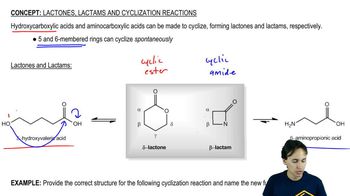
Lactones are cyclic esters formed from the intramolecular reaction of a hydroxy acid. In the presence of an acid catalyst, such as hydronium ion (H3O+), the hydroxyl group can be protonated, enhancing its leaving ability. This facilitates the nucleophilic attack of the hydroxyl group on the carbonyl carbon, leading to the formation of a cyclic structure.
Acid-catalyzed reactions involve the use of an acid to increase the rate of a chemical reaction. In this context, the acid protonates the hydroxyl groups, making them better leaving groups. This mechanism is crucial for the cyclization process, as it allows the formation of the lactone by stabilizing the transition state and promoting the formation of the cyclic product.
A reaction mechanism outlines the step-by-step process by which reactants convert to products. For the lactone formation, the mechanism includes protonation of the hydroxyl group, nucleophilic attack on the carbonyl carbon, and subsequent ring closure. Understanding the mechanism is essential for predicting the products and the conditions under which the reaction occurs.


 7:01 minutes
 Verified step by step guidance
 05:19
05:19