Describe the alkyne you should start with and the reagents you should use if you want to synthesize c. trans-2-pentene. d. 1-hexene.
Verified step by step guidance
1
Step 1: To synthesize trans-2-pentene, start with an alkyne that has the same carbon backbone as the desired product. In this case, the alkyne should be 2-pentyne (CH≡C-CH2-CH2-CH3). This ensures the correct positioning of the double bond in the final product.
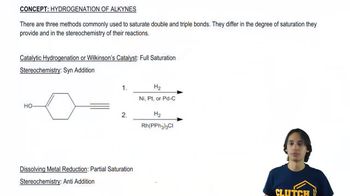
Step 2: Use a reduction reaction to convert the alkyne into the trans-alkene. The appropriate reagent for this transformation is sodium (Na) in liquid ammonia (NH3). This method selectively produces the trans-alkene due to the anti-addition mechanism.
Step 3: For the synthesis of 1-hexene, start with an alkyne that has the same carbon backbone as the desired product. In this case, the alkyne should be 1-hexyne (CH≡C-CH2-CH2-CH2-CH2-CH3). This ensures the double bond forms at the terminal position.
Step 4: Use a partial hydrogenation reaction to convert the alkyne into the alkene. The appropriate reagent for this transformation is Lindlar's catalyst (Pd/CaCO3 with quinoline). This method selectively produces the cis-alkene, but since 1-hexene is terminal, the stereochemistry is not relevant.
Step 5: Verify the product structures by considering the regioselectivity and stereoselectivity of the reactions. Ensure that the reagents used align with the desired product (trans-2-pentene or 1-hexene) and avoid over-reduction to alkanes.
Verified video answer for a similar problem:
This video solution was recommended by our tutors as helpful for the problem above
Video duration:
5m
Play a video:
0 Comments
Key Concepts
Here are the essential concepts you must grasp in order to answer the question correctly.
Alkynes
Alkynes are hydrocarbons that contain at least one carbon-carbon triple bond. They are unsaturated compounds and can be represented by the general formula CnH2n-2. Understanding the structure and reactivity of alkynes is crucial for synthesizing alkenes, as they can undergo various reactions, including hydrogenation and elimination, to form alkenes like trans-2-pentene and 1-hexene.
Hydrogenation is a chemical reaction that involves the addition of hydrogen (H2) to an unsaturated compound, such as an alkyne or alkene, to convert it into a saturated compound. This process is essential for synthesizing alkenes from alkynes, as it can selectively reduce the triple bond to a double bond, allowing for the formation of specific isomers like trans-2-pentene.
The choice of reagents is critical in organic synthesis, as they determine the pathway and outcome of the reaction. For synthesizing trans-2-pentene from an alkyne, reagents such as Lindlar's catalyst (for partial hydrogenation) or sodium in liquid ammonia (for trans-selective reduction) are commonly used. Understanding how these reagents interact with alkynes is key to achieving the desired product.