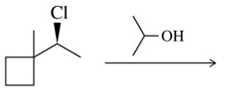
Predict the product of the following reactions. (b)
Verified step by step guidance
1
Step 1: Analyze the reactants. The starting material is a cyclobutyl compound with a chlorine atom attached to a secondary carbon. The reagent is isopropanol (CH3CHOHCH3), which can act as a nucleophile and solvent.
Step 2: Consider the reaction mechanism. Since the substrate is a secondary alkyl halide, the reaction could proceed via an SN1 or SN2 mechanism. However, the bulky cyclobutyl group and the polar protic solvent (isopropanol) favor the SN1 mechanism.
Step 3: In an SN1 mechanism, the first step is the formation of a carbocation. The chlorine atom leaves, generating a cyclobutyl carbocation. This step is the rate-determining step.
Step 4: The carbocation formed is relatively stable due to the ring strain in cyclobutane, which can stabilize the positive charge. The nucleophile (isopropanol) then attacks the carbocation, forming a new bond.
Step 5: After the nucleophilic attack, a proton is lost from the isopropanol group, resulting in the formation of the final product, which is an ether. The product will have the cyclobutyl group attached to the oxygen atom of the isopropanol.
Verified video answer for a similar problem:
This video solution was recommended by our tutors as helpful for the problem above
Video duration:
5m
Play a video:
0 Comments
Key Concepts
Here are the essential concepts you must grasp in order to answer the question correctly.
Reaction Mechanisms
Understanding reaction mechanisms is crucial in organic chemistry as they describe the step-by-step process by which reactants transform into products. This includes identifying intermediates, transition states, and the movement of electrons. Familiarity with mechanisms helps predict the outcome of reactions and the stability of products formed.
Functional groups are specific groups of atoms within molecules that are responsible for the characteristic chemical reactions of those molecules. Recognizing functional groups allows chemists to predict reactivity and the types of reactions that can occur. For example, alcohols, carboxylic acids, and amines each have distinct behaviors in chemical reactions.
Stereochemistry involves the study of the spatial arrangement of atoms in molecules and how this affects their chemical behavior. It is essential for predicting the products of reactions, especially in cases where chirality or geometric isomerism plays a role. Understanding stereochemistry helps in determining the specific isomers that may be produced in a reaction.