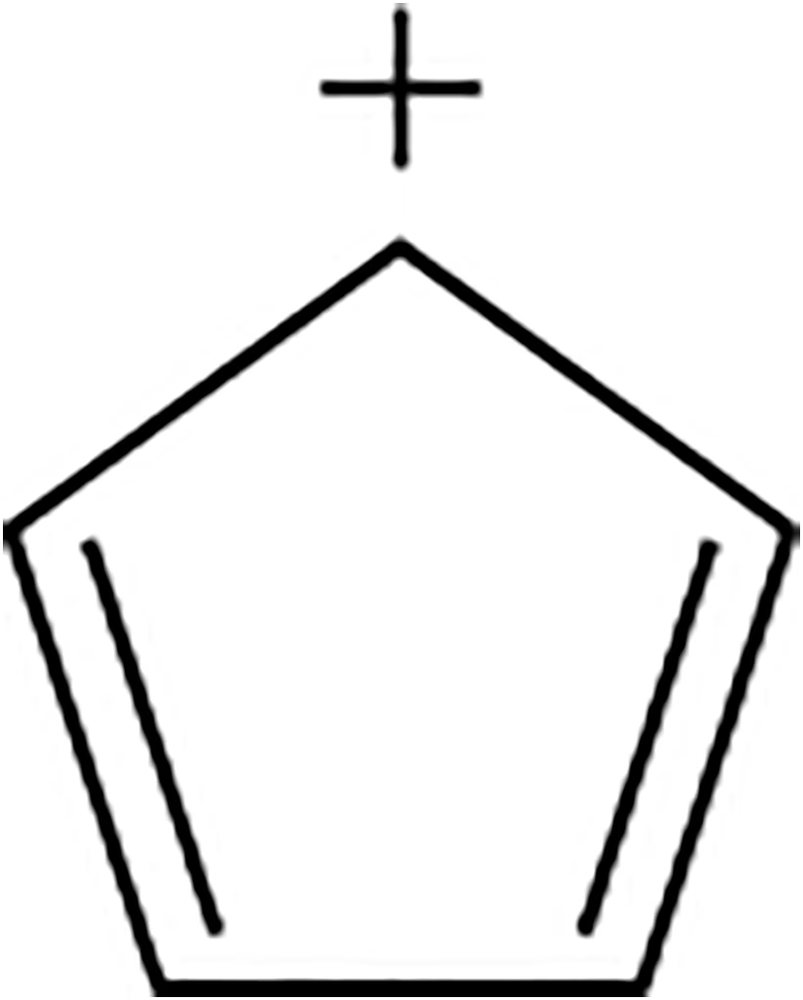
Draw a Frost circle for the cyclopentadienyl cation and compare it to the Frost circle for the cyclopentadienyl anion. What has changed?
Verified step by step guidance
1
To draw a Frost circle for the cyclopentadienyl cation, start by drawing a circle and inscribing a regular pentagon inside it. The vertices of the pentagon represent the energy levels of the molecular orbitals.
Position the pentagon such that one of its vertices is at the bottom of the circle. This represents the lowest energy molecular orbital.
For the cyclopentadienyl cation, which has 4 π electrons, fill the molecular orbitals starting from the lowest energy level. Each orbital can hold 2 electrons.
Now, compare this to the Frost circle for the cyclopentadienyl anion, which has 6 π electrons. The anion's Frost circle will have the same pentagon, but with 6 electrons filling the orbitals.
The key difference between the cation and anion Frost circles is the number of electrons. The cation has 4 electrons, leading to a different electron configuration and potentially different stability compared to the anion with 6 electrons.
Verified video answer for a similar problem:
This video solution was recommended by our tutors as helpful for the problem above
Video duration:
7m
Play a video:
0 Comments
Key Concepts
Here are the essential concepts you must grasp in order to answer the question correctly.
Frost Circle
A Frost circle is a graphical representation used to visualize the energy levels of molecular orbitals in cyclic compounds. It helps in determining the stability and electronic configuration of species like cations and anions by plotting the energy levels against the vertices of a polygon, typically a circle. The position of the orbitals indicates their energy, allowing for easy comparison between different species.
The cyclopentadienyl cation (C5H5+) and anion (C5H5-) are derived from cyclopentadiene by losing or gaining a hydrogen atom, respectively. The cation is electron-deficient and has a positive charge, while the anion is electron-rich and carries a negative charge. These changes in charge significantly affect their stability and reactivity, which can be analyzed through their respective Frost circles.
Molecular Orbital Theory explains how atomic orbitals combine to form molecular orbitals, which can be occupied by electrons. In the context of the cyclopentadienyl cation and anion, this theory helps in understanding how the addition or removal of electrons alters the energy levels and distribution of electrons in the molecular orbitals, influencing the overall stability and properties of the species.