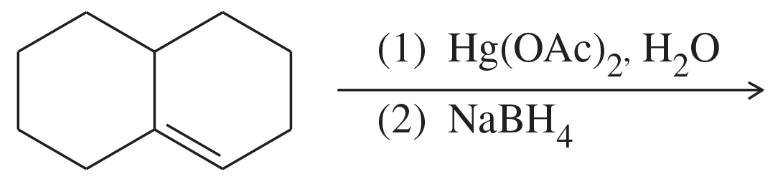
Predict the major products of the following reactions, and give the structures of any intermediates. Include stereochemistry where appropriate. (p)
Verified step by step guidance
1
Step 1: Recognize the reaction type. The reagents Hg(OAc)₂, H₂O, followed by NaBH₄, NaOH indicate an oxymercuration-demercuration reaction. This reaction adds water (H and OH) across a double bond in a Markovnikov fashion without rearrangement.
Step 2: Analyze the starting material. The first image shows a substituted cyclohexene, and the second image shows a bicyclic compound with a double bond. Both structures contain alkenes that will undergo addition reactions.
Step 3: Predict the intermediate. In the oxymercuration step, the alkene reacts with Hg(OAc)₂ and H₂O to form a mercurinium ion intermediate. The nucleophilic attack by water occurs at the more substituted carbon of the double bond, leading to the formation of an organomercury intermediate.
Step 4: Perform the demercuration step. In the second step, NaBH₄ reduces the organomercury intermediate, replacing the mercury group with a hydrogen atom. This completes the addition of H and OH across the double bond.
Step 5: Consider stereochemistry. The addition of H and OH occurs in an anti fashion due to the mechanism of the reaction. For the bicyclic compound, steric hindrance may influence the orientation of the added groups. Ensure to draw the major product with correct stereochemistry.
Verified video answer for a similar problem:
This video solution was recommended by our tutors as helpful for the problem above
Video duration:
9m
Play a video:
0 Comments
Key Concepts
Here are the essential concepts you must grasp in order to answer the question correctly.
Hydration of Alkenes
The hydration of alkenes involves the addition of water across a double bond, typically catalyzed by acids or metal salts. In this reaction, the alkene is converted into an alcohol. The use of mercuric acetate (Hg(OAc)2) in the presence of water facilitates the Markovnikov addition, where the hydroxyl group attaches to the more substituted carbon atom of the double bond.
Reduction reactions involve the gain of electrons or hydrogen, resulting in a decrease in oxidation state. In this context, sodium borohydride (NaBH4) is a common reducing agent that selectively reduces carbonyl compounds to alcohols. After the initial hydration step, NaBH4 can reduce any carbonyl intermediates formed, leading to the final alcohol product.
Stereochemistry refers to the spatial arrangement of atoms in molecules and how this affects their chemical behavior. In reactions involving chiral centers, the stereochemistry of the products can be crucial. When predicting products, it is important to consider whether the reaction leads to racemic mixtures or specific stereoisomers, especially in hydration and reduction processes where stereochemical outcomes can vary.