Show how you would accomplish the following transformations. Some of these examples require more than one step. (e) 2-chlorohexan-1-ol → 1,2-epoxyhexane
Verified step by step guidance
1
Step 1: Recognize that the transformation involves converting a 2-chlorohexan-1-ol into 1,2-epoxyhexane. This requires the formation of an epoxide, which typically involves an intramolecular reaction of a halohydrin.
Step 2: Begin by identifying the functional groups in the starting material. 2-chlorohexan-1-ol contains both a hydroxyl (-OH) group and a chloro (-Cl) group on adjacent carbons, which is ideal for epoxide formation.
Step 3: Treat the compound with a base, such as sodium hydroxide (NaOH). The base will deprotonate the hydroxyl group, forming an alkoxide ion (R-O⁻). This alkoxide ion is a strong nucleophile.
Step 4: The alkoxide ion will perform an intramolecular nucleophilic substitution (S_N2 mechanism) on the carbon bearing the chlorine atom. This results in the formation of the epoxide ring (1,2-epoxyhexane) and the elimination of the chloride ion (Cl⁻).
Step 5: Verify the stereochemistry of the product, if applicable, as the S_N2 mechanism can lead to inversion of configuration at the carbon where substitution occurs. Ensure the final product matches the desired structure of 1,2-epoxyhexane.
Verified video answer for a similar problem:
This video solution was recommended by our tutors as helpful for the problem above
Video duration:
2m
Play a video:
0 Comments
Key Concepts
Here are the essential concepts you must grasp in order to answer the question correctly.
Nucleophilic Substitution
Nucleophilic substitution is a fundamental reaction in organic chemistry where a nucleophile replaces a leaving group in a molecule. In the transformation from 2-chlorohexan-1-ol to 1,2-epoxyhexane, the chlorine atom acts as a leaving group, allowing a nucleophile to attack the carbon atom and facilitate the formation of a new bond.
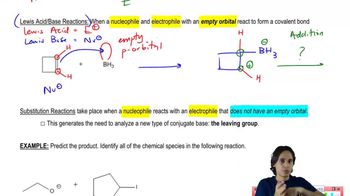
Nucleophiles and Electrophiles can react in Substitution Reactions.
Epoxidation
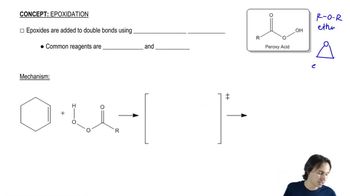
Epoxidation is the process of converting alkenes into epoxides, which are three-membered cyclic ethers. This transformation typically involves the reaction of an alkene with a peracid, leading to the formation of an epoxide. In the context of the given transformation, the formation of 1,2-epoxyhexane from 2-chlorohexan-1-ol may involve an intermediate alkene that undergoes epoxidation.
Stereochemistry refers to the study of the spatial arrangement of atoms in molecules and how this affects their chemical behavior. In the transformation to 1,2-epoxyhexane, understanding the stereochemistry is crucial, as the formation of the epoxide can lead to different stereoisomers depending on the configuration of the starting material and the reaction conditions.

 2:30 minutes
 Verified step by step guidance
 01:47
01:47