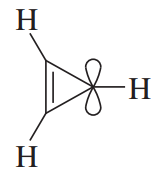
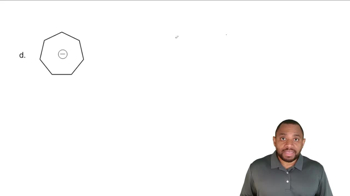
(a) Draw the molecular orbitals for the cyclopropenyl case. (Because there are three p orbitals, there must be three MOs: one all-bonding MO and one degenerate pair of MOs.) (b) Draw an energy diagram for the cyclopropenyl MOs. (The polygon rule is helpful.) Label each MO as bonding, nonbonding, or antibonding, and add the nonbonding line. Notice that it goes through the approximate average of the MOs. (c) Add electrons to your energy diagram to show the configuration of the cyclopropenyl cation and the cyclopropenyl anion. Which is aromatic and which is antiaromatic?
Verified step by step guidance
1
Step 1: Begin by identifying the cyclopropenyl system. Cyclopropenyl is a three-membered ring with conjugated π-electrons. The three p orbitals from the carbon atoms interact to form molecular orbitals.
Step 2: Draw the molecular orbitals (MOs) for the cyclopropenyl system. Since there are three p orbitals, there will be three MOs: one bonding MO (all p orbitals in-phase), one nonbonding MO (degenerate pair with one node), and one antibonding MO (all p orbitals out-of-phase). Use symmetry principles to sketch these orbitals.
Step 3: Construct an energy diagram using the polygon rule. The cyclopropenyl ring is triangular, so the energy levels of the MOs will follow the shape of the triangle. Place the bonding MO at the lowest energy, the degenerate nonbonding pair in the middle, and the antibonding MO at the highest energy. Label each MO as bonding, nonbonding, or antibonding.
Step 4: Add electrons to the energy diagram for the cyclopropenyl cation and anion. The cation has 2 π-electrons, which will fill the bonding MO, making it aromatic (Hückel's rule: 4n+2 π-electrons). The anion has 4 π-electrons, which will fill the bonding and nonbonding MOs, making it antiaromatic (4n π-electrons).
Step 5: Summarize the aromaticity. The cyclopropenyl cation is aromatic due to its 2 π-electrons satisfying Hückel's rule, while the cyclopropenyl anion is antiaromatic due to its 4 π-electrons violating Hückel's rule.
Verified video answer for a similar problem:
This video solution was recommended by our tutors as helpful for the problem above
Video duration:
9m
Play a video:
Was this helpful?
Key Concepts
Here are the essential concepts you must grasp in order to answer the question correctly.
Molecular Orbitals (MOs)
Molecular orbitals are formed by the combination of atomic orbitals when atoms bond together. In the case of cyclopropenyl, three p orbitals combine to create three MOs: one bonding and a degenerate pair of antibonding orbitals. Understanding how these orbitals are filled with electrons is crucial for predicting the molecule's stability and reactivity.
Aromatic compounds are cyclic, planar molecules with a continuous overlap of p orbitals, allowing for delocalized π electrons that follow Hückel's rule (4n + 2 π electrons). In contrast, antiaromatic compounds have 4n π electrons, leading to instability. Identifying whether cyclopropenyl cation or anion is aromatic or antiaromatic is essential for understanding their chemical behavior.
Energy diagrams visually represent the relative energy levels of molecular orbitals. They help in understanding the stability of a molecule based on the filling of these orbitals. In the case of cyclopropenyl, the energy diagram will show the bonding, nonbonding, and antibonding MOs, which are crucial for determining the electronic configuration of the cation and anion.