Give the structures of compounds A through C in the following series of reactions.
Verified step by step guidance
1
Step 1: Analyze the first reaction. The starting material is benzene, and it reacts with isobutyryl chloride (CH3CH(CH3)COCl) in the presence of AlCl3. This is a Friedel-Crafts acylation reaction, where the acyl group (CH3CH(CH3)CO-) is introduced onto the benzene ring to form compound A.
Step 2: Understand the mechanism of Friedel-Crafts acylation. AlCl3 acts as a Lewis acid, facilitating the generation of the acylium ion (CH3CH(CH3)C+=O), which is the electrophile. This electrophile reacts with benzene to form the ketone product (compound A).
Step 3: Examine the second reaction. Compound A undergoes a Clemmensen reduction using Zn(Hg) and HCl. This reaction reduces the carbonyl group (C=O) in compound A to a methylene group (-CH2-), resulting in compound C.
Step 4: Understand the Clemmensen reduction mechanism. Zn(Hg) in acidic conditions reduces the ketone functional group to an alkane, effectively removing the oxygen atom and replacing it with two hydrogen atoms.
Step 5: Summarize the transformations. Compound A is formed by the acylation of benzene with isobutyryl chloride, introducing a ketone group. Compound C is formed by reducing the ketone group in compound A to a methylene group via Clemmensen reduction.
Verified video answer for a similar problem:
This video solution was recommended by our tutors as helpful for the problem above
Video duration:
2m
Play a video:
0 Comments
Key Concepts
Here are the essential concepts you must grasp in order to answer the question correctly.
Reaction Mechanisms
Understanding reaction mechanisms is crucial in organic chemistry as it describes the step-by-step process by which reactants transform into products. This includes identifying intermediates, transition states, and the types of bonds formed or broken during the reaction. Familiarity with mechanisms helps predict the outcome of reactions and the structures of the resulting compounds.
Functional groups are specific groups of atoms within molecules that are responsible for the characteristic chemical reactions of those molecules. Recognizing functional groups is essential for predicting the behavior of organic compounds during reactions. Each functional group has distinct properties and reactivity patterns, which influence the overall structure of the compounds involved.
Stereochemistry involves the study of the spatial arrangement of atoms in molecules and how this affects their chemical behavior. It is important for understanding isomerism, where compounds with the same molecular formula can have different structures and properties. Knowledge of stereochemistry is vital when determining the correct structures of products in a series of reactions, especially when chiral centers are involved.

 2:38 minutes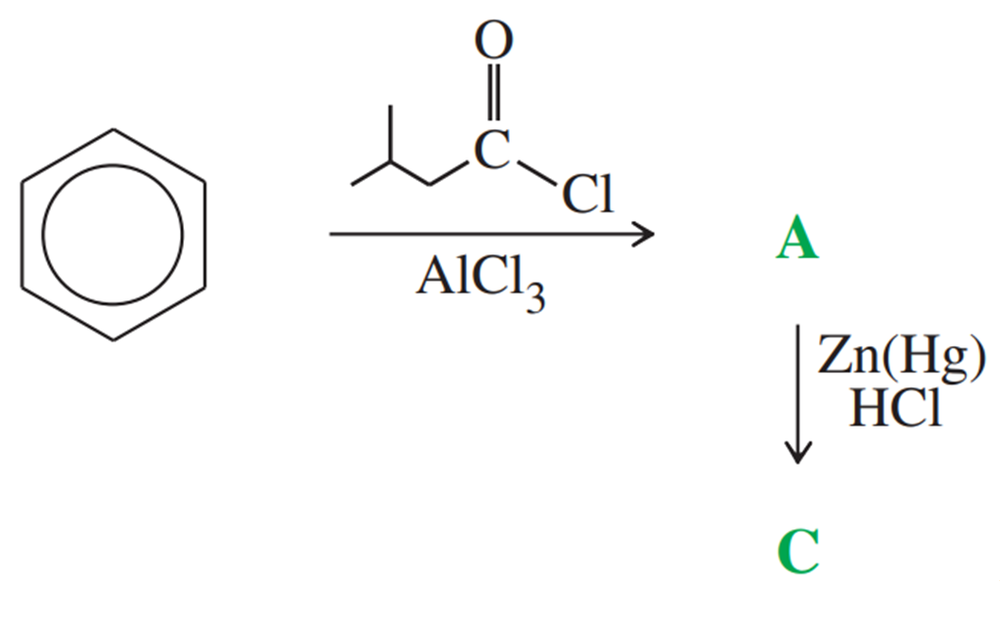
 Verified step by step guidance
 02:16
02:16