Show how you would use a Strecker synthesis to make phenylalanine.
Verified step by step guidance
1
Identify the starting materials for Strecker synthesis: Strecker synthesis involves the reaction of an aldehyde (or ketone), ammonia (NH₃), and hydrogen cyanide (HCN) to form an α-amino acid. For phenylalanine, the aldehyde needed is benzaldehyde (C₆H₅CHO).
React benzaldehyde with ammonia and hydrogen cyanide: In the first step, benzaldehyde reacts with ammonia (NH₃) to form an imine intermediate. Then, hydrogen cyanide (HCN) adds to the imine to produce an α-aminonitrile intermediate. The reaction can be represented as: .
Hydrolyze the α-aminonitrile: The α-aminonitrile is then hydrolyzed under acidic conditions (e.g., H₃O⁺) to convert the nitrile group (-CN) into a carboxylic acid (-COOH). This step produces phenylalanine. The reaction can be represented as: .
Verify the stereochemistry: Strecker synthesis typically produces a racemic mixture of the amino acid (both D- and L-forms). If a specific enantiomer of phenylalanine is required, additional steps such as chiral resolution or asymmetric synthesis may be necessary.
Summarize the overall process: The Strecker synthesis of phenylalanine involves starting with benzaldehyde, reacting it with ammonia and hydrogen cyanide to form an α-aminonitrile, and then hydrolyzing the nitrile group to yield phenylalanine.
Verified video answer for a similar problem:
This video solution was recommended by our tutors as helpful for the problem above
Video duration:
2m
Play a video:
0 Comments
Key Concepts
Here are the essential concepts you must grasp in order to answer the question correctly.
Strecker Synthesis
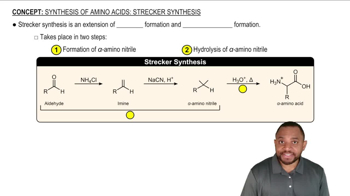
Strecker synthesis is a method for synthesizing amino acids through the reaction of an aldehyde with ammonia and hydrogen cyanide. This process involves the formation of an α-amino nitrile intermediate, which can be hydrolyzed to yield the corresponding amino acid. Understanding this reaction is crucial for constructing amino acids like phenylalanine from simpler organic compounds.
Synthesis of Amino Acids: Strecker Synthesis Concept 1
Amino Acids
Amino acids are organic compounds that serve as the building blocks of proteins. Each amino acid contains an amino group, a carboxyl group, and a distinctive side chain (R group) that determines its properties. Phenylalanine, specifically, is an essential amino acid with a benzyl side chain, making it important for protein synthesis and various metabolic processes.
Functional groups are specific groups of atoms within molecules that are responsible for the characteristic chemical reactions of those molecules. In the context of Strecker synthesis, the aldehyde, amino, and nitrile groups play critical roles in the formation of phenylalanine. Recognizing how these functional groups interact is essential for predicting the outcomes of organic reactions.

 2:00 minutes
 Verified step by step guidance
 1:39
1:39