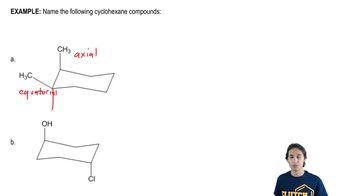
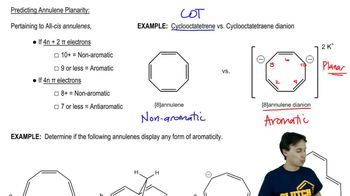
Given the following chair conformations, draw each in its planar form as if you were viewing it from above. (c)
Verified step by step guidance
1
Identify the chair conformation structure provided in the image. Note the positions of substituents (hydrogen atoms and alkyl groups) on the cyclohexane ring.
Determine the axial and equatorial positions of the substituents. Axial substituents are perpendicular to the plane of the ring, while equatorial substituents are roughly parallel to the plane of the ring.
Convert the chair conformation into a planar (flat) representation. In a planar form, the cyclohexane ring is drawn as a hexagon, and substituents are placed above or below the plane based on their axial or equatorial positions.
Place the substituents in their respective positions in the planar form. For example, substituents in axial positions will be drawn above or below the hexagon, while equatorial substituents will be drawn extending outward from the sides of the hexagon.
Ensure that the stereochemistry (up or down orientation) of each substituent is preserved in the planar form. Double-check the positions to confirm accuracy.
Verified video answer for a similar problem:
This video solution was recommended by our tutors as helpful for the problem above
Video duration:
1m
Play a video:
0 Comments
Key Concepts
Here are the essential concepts you must grasp in order to answer the question correctly.
Chair Conformation
The chair conformation is a three-dimensional representation of cyclohexane and its derivatives, which minimizes steric strain and torsional strain. In this conformation, carbon atoms are arranged in a staggered manner, allowing for more stable interactions between substituents. Understanding chair conformations is crucial for visualizing the spatial arrangement of atoms in cyclic compounds.
Cis and trans isomerism refers to the different spatial arrangements of substituents around a double bond or a ring structure. In cis isomers, substituents are on the same side, while in trans isomers, they are on opposite sides. This concept is essential for predicting the physical and chemical properties of organic molecules, as the arrangement can significantly influence reactivity and stability.
Planar representation involves drawing a molecule in two dimensions, typically to simplify the visualization of its structure. For chair conformations, this means translating the three-dimensional arrangement into a flat diagram, which can help in understanding the relative positions of substituents. This representation is particularly useful for comparing cis and trans configurations in cyclic compounds.


 1:40 minutes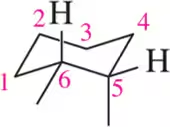
 Verified step by step guidance
 03:29
03:29