At the beginning of Chapter 9, we stated that after finishing Chapters 8 and 9, we would have the ability to make a large variety of functional groups using related reactions. Show the reagent(s) necessary to convert 1-isobutylcyclohexene into the following molecules. (f)
Verified step by step guidance
1
Analyze the structure of 1-isobutylcyclohexene. It contains a cyclohexene ring with an isobutyl group attached to one of the carbons in the ring. The double bond in the cyclohexene ring is the reactive site for most transformations.
Determine the functional group present in the target molecule (f). Identify the changes that need to occur in the starting material to achieve the target structure. For example, if the target molecule contains an alcohol, epoxide, or halide, consider reactions that can introduce these groups.
Select the appropriate reagent(s) for the transformation. For example:
- To add a hydroxyl group (alcohol), consider hydroboration-oxidation (e.g., BH₃ followed by H₂O₂/NaOH) or oxymercuration-demercuration (e.g., Hg(OAc)₂ in H₂O followed by NaBH₄).
- To form an epoxide, use a peracid such as mCPBA (meta-chloroperoxybenzoic acid).
- To add a halogen, use halogenation reagents like Br₂ or Cl₂ in an inert solvent.
Write the reaction mechanism for the transformation. For example, if hydroboration-oxidation is used, explain how the borane adds to the less substituted carbon of the double bond (anti-Markovnikov addition) and how oxidation replaces the boron with a hydroxyl group.
Verify the stereochemistry and regiochemistry of the product. Ensure that the reagent(s) chosen lead to the correct functional group and that the product matches the target molecule in terms of structure and stereochemistry.
Verified video answer for a similar problem:
This video solution was recommended by our tutors as helpful for the problem above
Video duration:
1m
Play a video:
0 Comments
Key Concepts
Here are the essential concepts you must grasp in order to answer the question correctly.
Functional Groups
Functional groups are specific groups of atoms within molecules that are responsible for the characteristic chemical reactions of those molecules. Understanding functional groups is essential in organic chemistry as they dictate the reactivity and properties of compounds. Examples include hydroxyl (-OH), carboxyl (-COOH), and amine (-NH2) groups, each influencing how a molecule interacts with others.
Reagents are substances that are added to a system to cause a chemical reaction or to see if a reaction occurs. In organic chemistry, different reagents are used to facilitate the transformation of one functional group into another. For instance, reagents like bromine (Br2) can be used for halogenation, while sulfuric acid (H2SO4) can promote dehydration reactions.
A reaction mechanism is a step-by-step description of how a chemical reaction occurs at the molecular level. It outlines the sequence of events, including bond breaking and forming, and the intermediates involved. Understanding mechanisms is crucial for predicting the products of reactions and for designing synthetic pathways to create desired compounds from starting materials.

 1:43 minutes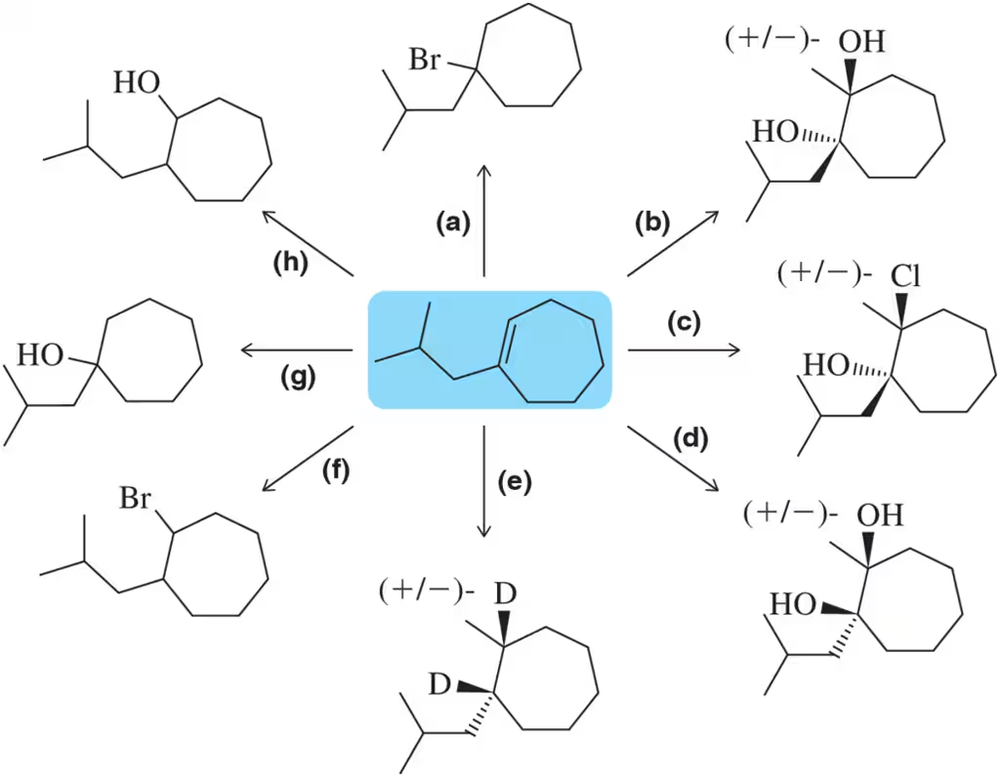
 Verified step by step guidance
 02:36
02:36