One of the crowning achievements of natural products synthesis was Bryostatin 1, published by Professor Gary Keck (University of Utah; Journal of the American Chemical Society, 2011, 133, 744–747). The Bryostatins are a familyof compounds isolated from aquatic invertebrates known as Bryozoans. The compounds are of interest for a variety of biological effects, including anti-cancer activity and reversing brain damage in rodents.(d) How many chiral centers are in this molecule?(e) Using the number of chiral centers you reported in part(d), calculate the number of stereoisomers possible atthese chiral centers. (Ignore stereoisomers at double bonds.)
Verified step by step guidance
1
Identify all the chiral centers in the Bryostatin 1 molecule. A chiral center is typically a carbon atom that is bonded to four different groups.
Count the number of chiral centers identified in the molecule.
Use the formula for calculating the number of stereoisomers: 2^n, where n is the number of chiral centers.
Substitute the number of chiral centers found in step 2 into the formula from step 3.
Calculate the number of possible stereoisomers based on the formula.
Verified video answer for a similar problem:
This video solution was recommended by our tutors as helpful for the problem above
Video duration:
2m
Play a video:
0 Comments
Key Concepts
Here are the essential concepts you must grasp in order to answer the question correctly.
Chirality
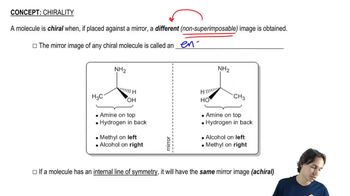
Chirality refers to the geometric property of a molecule that makes it non-superimposable on its mirror image, much like left and right hands. A chiral center, typically a carbon atom, is bonded to four different substituents, leading to two distinct configurations known as enantiomers. Understanding chirality is crucial for determining the spatial arrangement of atoms in a molecule, which directly influences its chemical behavior and biological activity.
Stereoisomers are compounds that have the same molecular formula and connectivity of atoms but differ in the spatial arrangement of their atoms. This category includes enantiomers, which are mirror images of each other, and diastereomers, which are not. The number of stereoisomers for a molecule can be calculated using the formula 2^n, where n is the number of chiral centers, highlighting the complexity and diversity of potential molecular configurations.
To calculate the number of stereoisomers for a molecule with chiral centers, one can use the formula 2^n, where n represents the number of chiral centers present. This formula assumes that all chiral centers are independent and can exist in both configurations (R and S). It is important to note that this calculation does not account for any symmetry in the molecule, which could reduce the total number of unique stereoisomers.

 2:05 minutes
 Verified step by step guidance
 05:10
05:10