Pearson+ LogoPearson+ Logo
Ch.18 Amino Acids and Proteins
McMurry - Fundamentals of GOB 8th Edition
McMurry8th EditionFundamentals of GOBISBN: 9780134015187Not the one you use?Change textbook
Chapter 18, Problem 84b

What is meant by the following terms as they apply to protein structure, and what bonds or molecular interactions stabilize that level of structure?
b. Secondary structure

Verified step by step guidance
1
Understand that the secondary structure of a protein refers to the local folding of the polypeptide chain into specific patterns, such as alpha-helices and beta-pleated sheets. These structures are stabilized by hydrogen bonds between the backbone amide hydrogen (N-H) and carbonyl oxygen (C=O) groups of the polypeptide chain.
Recognize that alpha-helices are coiled structures where the hydrogen bonds form between the carbonyl oxygen of one amino acid and the amide hydrogen of an amino acid four residues away. This creates a helical shape.
Identify that beta-pleated sheets consist of strands of polypeptides lying side by side, which can be parallel or antiparallel. Hydrogen bonds form between the carbonyl oxygen of one strand and the amide hydrogen of another strand, stabilizing the sheet-like structure.
Note that secondary structures do not involve interactions between the side chains (R groups) of amino acids; they are solely dependent on the backbone interactions.
Understand that the stability of secondary structures is influenced by the sequence of amino acids, as certain residues (e.g., proline) can disrupt these structures due to their unique properties.

Verified video answer for a similar problem:

This video solution was recommended by our tutors as helpful for the problem above.
Was this helpful?

Key Concepts

Here are the essential concepts you must grasp in order to answer the question correctly.

Secondary Structure

Secondary structure refers to the local folding patterns of a protein, primarily stabilized by hydrogen bonds between the backbone amide and carbonyl groups. The most common forms of secondary structure are alpha helices and beta sheets, which contribute to the overall shape and stability of the protein. These structures are crucial for the protein's function, as they create specific spatial arrangements that facilitate interactions with other molecules.
Recommended video:
Guided course
1:24
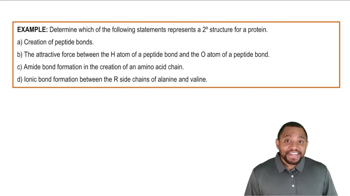
Secondary Protein Structure Example 2

Hydrogen Bonds

Hydrogen bonds are weak interactions that occur when a hydrogen atom covalently bonded to an electronegative atom, like oxygen or nitrogen, is attracted to another electronegative atom. In the context of secondary structure, these bonds form between the carbonyl oxygen of one amino acid and the amide hydrogen of another, helping to stabilize the helical or sheet formations. Although individually weak, the cumulative effect of many hydrogen bonds significantly contributes to the stability of protein structures.
Recommended video:
Guided course
1:22
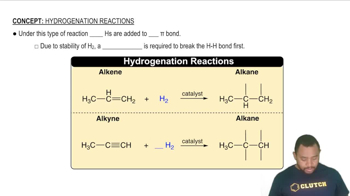
Hydrogenation Reactions Concept 1

Protein Folding

Protein folding is the process by which a linear chain of amino acids acquires its functional three-dimensional structure. This process is driven by various interactions, including hydrogen bonds, hydrophobic interactions, and van der Waals forces. Proper folding is essential for protein functionality, as misfolded proteins can lead to loss of function or diseases, highlighting the importance of secondary structure in the overall stability and activity of proteins.
Recommended video:
Guided course
1:17
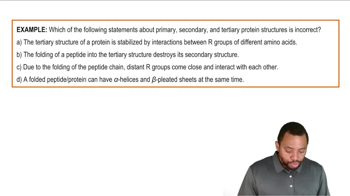
Tertiary Protein Structure Example 1