Pearson+ LogoPearson+ Logo
Ch.18 Amino Acids and Proteins
McMurry - Fundamentals of GOB 8th Edition
McMurry8th EditionFundamentals of GOBISBN: 9780134015187Not the one you use?Change textbook
Chapter 18, Problem 84d

What is meant by the following terms as they apply to protein structure, and what bonds or molecular interactions stabilize that level of structure?
d. Quaternary structure

Verified step by step guidance
1
Understand that the quaternary structure of a protein refers to the arrangement and interaction of multiple polypeptide chains (subunits) in a multi-subunit protein complex. This is the highest level of protein structure.
Recognize that the quaternary structure is stabilized by various types of bonds and interactions between the subunits. These include hydrogen bonds, ionic bonds, hydrophobic interactions, and van der Waals forces.
Note that disulfide bonds (covalent bonds between cysteine residues) can also play a role in stabilizing the quaternary structure in some proteins.
Consider examples of proteins with quaternary structures, such as hemoglobin, which consists of four subunits (two alpha and two beta chains) that work together to transport oxygen.
Understand that the quaternary structure is essential for the protein's biological function, as the arrangement of subunits often determines how the protein interacts with other molecules or performs its role in the cell.

Verified video answer for a similar problem:

This video solution was recommended by our tutors as helpful for the problem above.
Was this helpful?

Key Concepts

Here are the essential concepts you must grasp in order to answer the question correctly.

Quaternary Structure

Quaternary structure refers to the highest level of protein organization, where multiple polypeptide chains, or subunits, come together to form a functional protein complex. This arrangement can involve identical or different subunits, and the specific interactions between them are crucial for the protein's overall function.
Recommended video:
Guided course
3:26
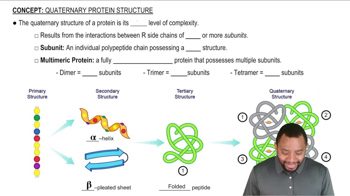
Quaternary Protein Structure Concept 1

Types of Bonds

The stability of quaternary structure is primarily maintained by various types of bonds and interactions, including hydrogen bonds, ionic bonds, hydrophobic interactions, and disulfide bridges. These interactions help to hold the subunits together, ensuring that the protein maintains its functional conformation under physiological conditions.
Recommended video:
Guided course
01:08
Nuclear vs Chemical Reactions

Protein Functionality

The quaternary structure is essential for the functionality of many proteins, as it allows for cooperative interactions between subunits, which can enhance the protein's activity. For example, in hemoglobin, the binding of oxygen to one subunit increases the affinity of the other subunits for oxygen, demonstrating how quaternary structure can influence biological activity.
Recommended video:
Guided course
02:16
Logarithmic Functions