Pearson+ LogoPearson+ Logo
Ch.15 Aldehydes and Ketones
McMurry - Fundamentals of GOB 8th Edition
McMurry8th EditionFundamentals of GOBISBN: 9780134015187Not the one you use?Change textbook
Chapter 15, Problem 20b

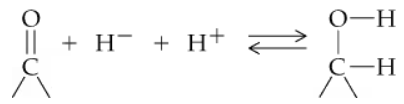
The carbonyl group can be reduced by addition of a hydride ion (H) and (H+) a proton. Removal of H and H+ from an alcohol results in a carbonyl group.

b. In the reaction, indicate which direction represents reduction and which represents oxidation.

Verified step by step guidance
1
Understand the key concepts: Reduction involves the gain of electrons or hydrogen (H⁻ and H⁺), while oxidation involves the loss of electrons or hydrogen. In organic chemistry, reduction often converts a carbonyl group (C=O) to an alcohol (C-OH), and oxidation does the reverse.
Identify the functional groups involved: A carbonyl group (C=O) is being converted to an alcohol (C-OH) in one direction, and the alcohol is being converted back to a carbonyl group in the opposite direction.
Determine the direction of reduction: The addition of H⁻ (hydride ion) and H⁺ (proton) to the carbonyl group (C=O) results in the formation of an alcohol (C-OH). This process represents reduction because hydrogen is being added.
Determine the direction of oxidation: The removal of H⁻ (hydride ion) and H⁺ (proton) from the alcohol (C-OH) results in the formation of a carbonyl group (C=O). This process represents oxidation because hydrogen is being removed.
Summarize the directions: The conversion of a carbonyl group (C=O) to an alcohol (C-OH) is reduction, while the conversion of an alcohol (C-OH) to a carbonyl group (C=O) is oxidation.

Verified video answer for a similar problem:

This video solution was recommended by our tutors as helpful for the problem above.
Was this helpful?

Key Concepts

Here are the essential concepts you must grasp in order to answer the question correctly.

Reduction and Oxidation

Reduction and oxidation are fundamental chemical processes that involve the transfer of electrons. Reduction refers to the gain of electrons or hydrogen, while oxidation involves the loss of electrons or hydrogen. In organic chemistry, the addition of a hydride ion (H⁻) to a carbonyl group signifies reduction, whereas the removal of H⁻ and H⁺ from an alcohol to form a carbonyl indicates oxidation.
Recommended video:
Guided course
0:55
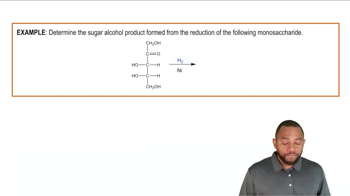
Reduction of Monosaccharides Example 1

Carbonyl Group

The carbonyl group (C=O) is a functional group characterized by a carbon atom double-bonded to an oxygen atom. It is a key feature in various organic compounds, including aldehydes and ketones. Understanding the reactivity of the carbonyl group is essential for predicting the outcomes of reduction and oxidation reactions, as it can easily undergo transformations with the addition or removal of hydrogen.
Recommended video:
Guided course
1:00
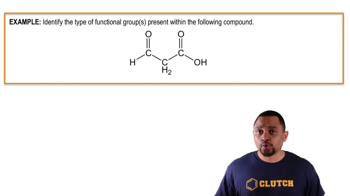
Functional Groups with Carbonyls Example 3

Hydride Ion (H⁻)

A hydride ion (H⁻) is a negatively charged ion formed when a hydrogen atom gains an electron. In reduction reactions, hydride ions act as strong reducing agents, donating electrons to other molecules, such as carbonyl compounds. This process is crucial in organic synthesis, as it allows for the conversion of carbonyl groups into alcohols, demonstrating the practical applications of reduction in chemical reactions.
Recommended video:
Guided course
02:31
Polyatomic Ions