Pearson+ LogoPearson+ Logo
Ch.21 The Generation of Biochemical Energy
McMurry - Fundamentals of GOB 8th Edition
McMurry8th EditionFundamentals of GOBISBN: 9780134015187Not the one you use?Change textbook
Chapter 21, Problem 26

The electron-transport chain uses several different metal ions, especially iron, copper, zinc, and manganese. Why are metals used frequently in these two pathways? What can metals do better than organic biomolecules?

Verified step by step guidance
1
Metals are frequently used in the electron-transport chain because they have unique properties that make them highly effective in facilitating electron transfer reactions.
Metals, such as iron and copper, can exist in multiple oxidation states. This allows them to easily gain or lose electrons, which is essential for the stepwise transfer of electrons in the electron-transport chain.
Unlike organic biomolecules, metals can form coordination complexes with ligands, stabilizing their various oxidation states and enabling precise control over electron transfer processes.
Metals also have high electrical conductivity, which allows them to efficiently transfer electrons over short distances within the protein complexes of the electron-transport chain.
In summary, metals are better suited than organic biomolecules for electron transfer because of their ability to change oxidation states, form stable complexes, and conduct electricity effectively.

Verified video answer for a similar problem:

This video solution was recommended by our tutors as helpful for the problem above.
Video duration:
7m
Was this helpful?

Key Concepts

Here are the essential concepts you must grasp in order to answer the question correctly.

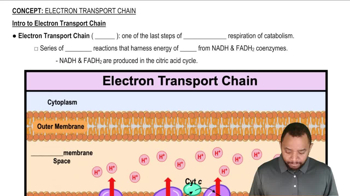
Electron Transport Chain (ETC)

The electron transport chain is a series of protein complexes and other molecules located in the inner mitochondrial membrane that facilitate the transfer of electrons from electron donors to electron acceptors. This process is crucial for ATP production through oxidative phosphorylation, where energy released from electron transfers is used to pump protons across the membrane, creating a proton gradient.
Recommended video:
Guided course
3:10
Intro to Electron Transport Chain Concept 1

Role of Metal Ions in Biochemical Reactions

Metal ions, such as iron, copper, zinc, and manganese, play essential roles as cofactors in various biochemical reactions. They can stabilize negative charges, facilitate electron transfer, and participate in redox reactions, which are vital for energy production and metabolic processes. Their unique properties allow them to perform functions that organic biomolecules cannot, such as efficiently conducting electrons.
Recommended video:
Guided course
1:08
Energy Production In Biochemical Pathways Example 1

Comparison of Metals and Organic Biomolecules

Metals are often more effective than organic biomolecules in certain biochemical roles due to their ability to exist in multiple oxidation states and their capacity to form coordination complexes. This versatility allows metals to participate in electron transfer and catalysis more efficiently than organic molecules, which typically rely on covalent bonding and may not provide the same level of reactivity or stability in dynamic cellular environments.
Recommended video:
Guided course
2:26
Introduction to Organic Chemistry Concept 1