Pearson+ LogoPearson+ Logo
Ch.21 The Generation of Biochemical Energy
McMurry - Fundamentals of GOB 8th Edition
McMurry8th EditionFundamentals of GOBISBN: 9780134015187Not the one you use?Change textbook
Chapter 21, Problem 24c

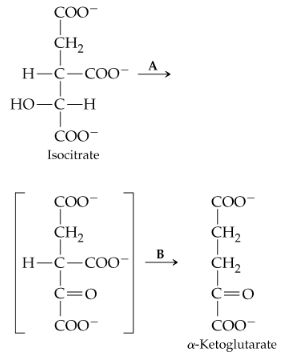
The reaction that follows is catalyzed by isocitrate dehydrogenase and occurs in two steps, the first of which (step A) is formation of an unstable intermediates (shown in brackets).

c. Which of the structures shown can be described as a β-keto acid?

Verified step by step guidance
1
Step 1: Understand the term 'ß-keto acid'. A ß-keto acid is a molecule that contains both a ketone group (C=O) and a carboxylic acid group (-COOH), where the ketone group is located on the carbon atom that is beta (two carbons away) from the carboxylic acid group.
Step 2: Examine the structures provided in the problem. Identify the functional groups present in each structure, specifically looking for a ketone group and a carboxylic acid group.
Step 3: Determine the relative positions of the ketone group and the carboxylic acid group in each structure. Check if the ketone group is located on the beta carbon relative to the carboxylic acid group.
Step 4: Identify the structure(s) that meet the criteria for a ß-keto acid. This involves confirming that the ketone group is exactly two carbons away from the carboxylic acid group.
Step 5: Conclude which structure(s) can be described as a ß-keto acid based on the analysis of their functional groups and relative positions.

Verified video answer for a similar problem:

This video solution was recommended by our tutors as helpful for the problem above.
Video duration:
3m
Was this helpful?

Key Concepts

Here are the essential concepts you must grasp in order to answer the question correctly.

Isocitrate Dehydrogenase

Isocitrate dehydrogenase is an enzyme that plays a crucial role in the citric acid cycle (Krebs cycle), catalyzing the oxidative decarboxylation of isocitrate to alpha-ketoglutarate. This reaction is significant for energy production and metabolic regulation. Understanding its function helps in grasping how intermediates are formed and transformed during cellular respiration.
Recommended video:
Guided course
1:47
Phase B - Succinyl CoA Formation Concept 5

ß-Keto Acid

A ß-keto acid is a type of organic compound that contains a ketone group (C=O) at the beta position relative to a carboxylic acid group (–COOH). This structure is important in various biochemical pathways, including metabolism and the synthesis of amino acids. Identifying ß-keto acids is essential for understanding their role in metabolic reactions and their potential as intermediates.
Recommended video:

Unstable Intermediates

Unstable intermediates are transient species formed during chemical reactions that have a short lifespan and are often highly reactive. In enzymatic reactions, these intermediates can influence the reaction pathway and the overall kinetics. Recognizing these intermediates is vital for understanding the mechanisms of enzyme-catalyzed reactions and the stability of the products formed.
Recommended video:
Guided course
0:35
Overview of Protein Synthesis Example 1