Pearson+ LogoPearson+ Logo
Ch.19 Enzymes and Vitamins
McMurry - Fundamentals of GOB 8th Edition
McMurry8th EditionFundamentals of GOBISBN: 9780134015187Not the one you use?Change textbook
Chapter 19, Problem 57c

What general effects would you expect the following changes to have on the rate of an enzyme-catalyzed reaction for an enzyme that has its maximum activity at body temperature (about 37°C)?
c. Adding an oxidizing agent, such as hydrogen peroxide

Verified step by step guidance
1
Understand the role of an oxidizing agent: An oxidizing agent, such as hydrogen peroxide (H₂O₂), can cause oxidative damage to proteins, including enzymes. This may lead to changes in the enzyme's structure and function.
Recall the importance of enzyme structure: Enzymes are proteins that rely on their specific three-dimensional structure to function properly. Oxidative agents can disrupt this structure by modifying amino acid side chains or breaking disulfide bonds.
Consider the effect on the active site: If the oxidizing agent alters the enzyme's active site, the substrate may no longer bind effectively, reducing the enzyme's catalytic activity.
Evaluate the overall impact on reaction rate: If the enzyme is damaged or its active site is altered, the rate of the enzyme-catalyzed reaction is likely to decrease or stop entirely, depending on the extent of the damage.
Conclude the expected effect: Adding an oxidizing agent, such as hydrogen peroxide, would generally decrease the rate of an enzyme-catalyzed reaction by interfering with the enzyme's structure and function.

Verified video answer for a similar problem:

This video solution was recommended by our tutors as helpful for the problem above.
Video duration:
3m
Was this helpful?

Key Concepts

Here are the essential concepts you must grasp in order to answer the question correctly.

Enzyme Activity

Enzyme activity refers to the rate at which an enzyme catalyzes a reaction. Factors such as temperature, pH, and substrate concentration can influence this activity. Enzymes typically have an optimal temperature range, and deviations from this range can lead to decreased activity or denaturation.
Recommended video:
Guided course
1:06
Factors Affecting Enzyme Activity Concept 1

Oxidizing Agents

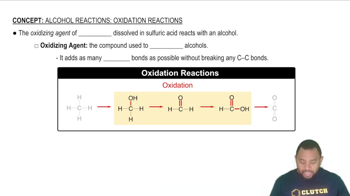
Oxidizing agents, like hydrogen peroxide, can affect enzyme activity by altering the enzyme's structure or the substrate's availability. They can lead to the formation of reactive oxygen species, which may either inhibit or enhance enzyme function depending on the specific enzyme and reaction conditions.
Recommended video:
Guided course
1:49
Alcohol Reactions: Oxidation Concept 1

Reaction Rate

The reaction rate is the speed at which reactants are converted into products in a chemical reaction. In enzyme-catalyzed reactions, the rate can be influenced by factors such as enzyme concentration, substrate concentration, and the presence of inhibitors or activators, including oxidizing agents.
Recommended video:
Guided course
01:07
Rate of Reaction Concept 1
Related Practice
Textbook Question

How do you explain the observation that pepsin, a digestive enzyme found in the stomach, has a high catalytic activity at pH 1.5, while trypsin, an enzyme of the small intestine, has no activity at pH 1.5?

Textbook Question

What general effects would you expect the following changes to have on the rate of an enzyme-catalyzed reaction for an enzyme that has its maximum activity at body temperature (about 37°C)?

a. Raising the temperature from 37°C to 70°C

Textbook Question

What general effects would you expect the following changes to have on the rate of an enzyme-catalyzed reaction for an enzyme that has its maximum activity at body temperature (about 37°C)?

c. Adding an organic solvent, such as methanol

Textbook Question

The text discusses three forms of enzyme inhibition: uncompetitive inhibition, competitive inhibition, and irreversible inhibition.

b. What kinds of bonds are formed between an enzyme and each of these three kinds of inhibitors?

Textbook Question

What kind of inhibition (uncompetitive, competitive, or irreversible) is present in each of the following:

a. Penicillin is used to treat certain bacterial infections. Penicillin is effective because it binds to the enzyme glycopeptide transpeptidase and does not dissociate.

Textbook Question

What kind of inhibition (uncompetitive, competitive, or irreversible) is present in each of the following:

c. The antibiotic deoxycycline inhibits the bacterial enzyme collagenase, slowing bacterial growth. Deoxycycline does not fit into the active site of collagenase and binds elsewhere on the enzyme.