Pearson+ LogoPearson+ Logo
Ch.14 Some Compounds with Oxygen, Sulfur, or a Halogen
McMurry - Fundamentals of GOB 8th Edition
McMurry8th EditionFundamentals of GOBISBN: 9780134015187Not the one you use?Change textbook
Chapter 14, Problem 75

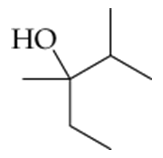
Using the alcohol shown, draw all the possible alkenes that might be formed on its dehydration. Which alkenes can exist as cistrans isomers? Draw them, in both condensed and line structure, and identify each as cis or trans. Explain your choices.

Verified step by step guidance
1
Identify the alcohol functional group in the given molecule. Dehydration of alcohols involves the removal of a water molecule, which includes the hydroxyl group (-OH) and a hydrogen atom from an adjacent carbon atom.
Determine all possible β-hydrogens (hydrogens on carbons adjacent to the carbon bearing the -OH group). Each β-hydrogen can lead to a different alkene product when removed during dehydration.
Apply Zaitsev's rule, which states that the more substituted alkene (the one with more alkyl groups attached to the double-bonded carbons) is generally the major product. Identify all possible alkenes that can form, considering both major and minor products.
For each alkene, analyze the geometry of the double bond. If the double bond has two different groups attached to each of the double-bonded carbons, it can exhibit cis-trans (geometric) isomerism. Draw the cis and trans forms for these alkenes, using both condensed and line structures.
Explain why certain alkenes can or cannot exhibit cis-trans isomerism. This depends on whether the double-bonded carbons have two different substituents. Label each isomer as cis (same side) or trans (opposite sides) based on the relative positions of the substituents.

Verified video answer for a similar problem:

This video solution was recommended by our tutors as helpful for the problem above.
Was this helpful?

Key Concepts

Here are the essential concepts you must grasp in order to answer the question correctly.

Dehydration of Alcohols

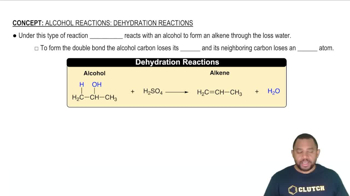
Dehydration of alcohols is a chemical reaction where an alcohol loses a water molecule, typically resulting in the formation of an alkene. This process often occurs in the presence of an acid catalyst and can lead to the formation of multiple alkenes depending on the structure of the starting alcohol. Understanding this reaction is crucial for predicting the possible alkenes that can be formed.
Recommended video:
Guided course
1:30
Alcohol Reactions: Dehydration Reactions Concept 1

Cis-Trans Isomerism

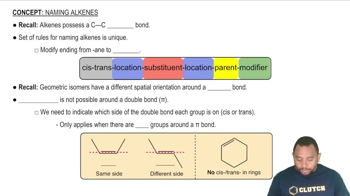
Cis-trans isomerism, also known as geometric isomerism, occurs in alkenes due to the restricted rotation around the carbon-carbon double bond. In this context, 'cis' refers to isomers where substituents are on the same side of the double bond, while 'trans' indicates they are on opposite sides. Identifying which alkenes can exhibit this isomerism is essential for drawing and labeling the structures correctly.
Recommended video:
Guided course
2:47
Rules for Naming Alkenes Concept 1

Condensed and Line Structures

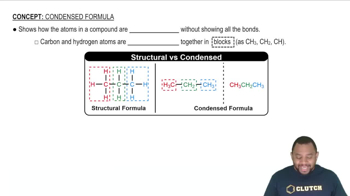
Condensed and line structures are two ways to represent chemical compounds. A condensed structure shows the arrangement of atoms in a linear format, often omitting some bonds for simplicity, while a line structure uses lines to represent bonds and vertices to represent carbon atoms. Understanding how to draw and interpret both structures is important for accurately depicting the alkenes formed from the dehydration of alcohols.
Recommended video:
Guided course
1:53
Condensed Formula Concept 1