Pearson+ LogoPearson+ Logo
Ch.21 The Generation of Biochemical Energy
McMurry - Fundamentals of GOB 8th Edition
McMurry8th EditionFundamentals of GOBISBN: 9780134015187Not the one you use?Change textbook
Chapter 21, Problem 21c

Each of these reactions is involved in one of the four stages of metabolism shown in Figure 21.4. Identify the stage in which each reaction occurs.
<IMAGE>
c. Conversion of glucose to acetyl-CoA

Verified step by step guidance
1
Understand the four stages of metabolism: (1) Digestion, (2) Production of acetyl-CoA, (3) Citric acid cycle, and (4) Electron transport chain and oxidative phosphorylation. These stages describe how the body processes nutrients to produce energy.
Recognize that glucose is a carbohydrate, and its metabolism begins with glycolysis, a process that breaks down glucose into smaller molecules.
Recall that glycolysis converts glucose (a six-carbon molecule) into two molecules of pyruvate (a three-carbon molecule). This process occurs in the cytoplasm and is part of the first stage of metabolism (digestion).
Understand that pyruvate is further processed to form acetyl-CoA. This conversion involves the enzyme pyruvate dehydrogenase, which removes a carbon from pyruvate as carbon dioxide (CO₂) and attaches the remaining two-carbon fragment to coenzyme A, forming acetyl-CoA. This step occurs in the mitochondria.
Identify that the conversion of glucose to acetyl-CoA is part of the second stage of metabolism, which is the production of acetyl-CoA. This stage bridges glycolysis and the citric acid cycle, preparing the acetyl-CoA for energy production in subsequent stages.

Verified video answer for a similar problem:

This video solution was recommended by our tutors as helpful for the problem above.
Video duration:
5m
Was this helpful?

Key Concepts

Here are the essential concepts you must grasp in order to answer the question correctly.

Metabolism

Metabolism refers to the set of life-sustaining chemical reactions in organisms that convert food into energy and building blocks for growth. It is divided into two main categories: catabolism, which breaks down molecules to release energy, and anabolism, which uses energy to construct components of cells. Understanding metabolism is crucial for identifying how different biochemical processes are interconnected.
Recommended video:
Guided course
0:52
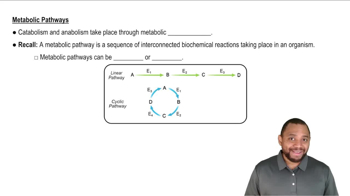
Metabolic Pathways Concept 2

Glycolysis

Glycolysis is the metabolic pathway that converts glucose into pyruvate, producing a small amount of ATP and NADH in the process. This pathway occurs in the cytoplasm and is the first step in both aerobic and anaerobic respiration. The conversion of glucose to acetyl-CoA follows glycolysis and is essential for entering the citric acid cycle.
Recommended video:
Guided course
1:26
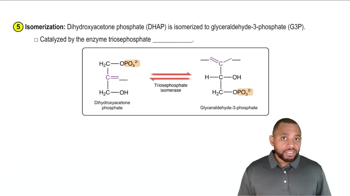
Glycolysis Concept 5

Acetyl-CoA

Acetyl-CoA is a central metabolite in energy production and biosynthesis, formed from the breakdown of carbohydrates, fats, and proteins. It serves as a key substrate for the citric acid cycle, where it is oxidized to produce ATP. The conversion of pyruvate (from glycolysis) to acetyl-CoA is a critical transition point in cellular respiration, linking glycolysis to the citric acid cycle.
Recommended video:
Guided course
1:33
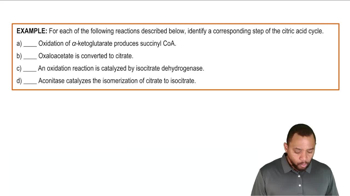
Phase B - Succinyl CoA Formation Example 2
Related Practice
Textbook Question

The reduced coenzymes NADH and FADH2 are oxidized in the ETS. What is the final electron acceptor of the ETS? What is the function of the H+ ion in ATP synthesis?

Textbook Question

Each of these reactions is involved in one of the four stages of metabolism shown in Figure 21.4. Identify the stage in which each reaction occurs.

<IMAGE>

a. Hydrolysis of starch to produce glucose

1
views
Textbook Question

Each of these reactions is involved in one of the four stages of metabolism shown in Figure 21.4. Identify the stage in which each reaction occurs.

<IMAGE>

b. Oxidation of NADH coupled with synthesis of ATP

1
views
Textbook Question

For the first step in fatty acid catabolism, we say that ATP is used to “drive” the reaction that links the fatty acid with coenzyme-A. Without ATP hydrolysis, would you predict that the linking of fatty acid to coenzyme-A would be ­exergonic or endergonic? In fatty acid CoA synthesis, the hydrolysis of the ATP portion is based on what major strategy of metabolism?

Textbook Question

Since no molecular oxygen participates in the citric acid cycle, the steps in which acetyl groups are oxidized to CO2 involve removal of hydride ions and hydrogen ions. What is the acceptor of hydride ions? What is the acceptor of hydrogen ions?

Textbook Question

The reaction that follows is catalyzed by isocitrate dehydrogenase and occurs in two steps, the first of which (step A) is formation of an unstable intermediates (shown in brackets).

a. In which step is a coenzyme needed? Identify the coenzyme.