
Pearson+ LogoPearson+ Logo
Ch.20 Carbohydrates
McMurry - Fundamentals of GOB 8th Edition
McMurry8th EditionFundamentals of GOBISBN: 9780134015187Not the one you use?Change textbook
Chapter 20, Problem 31d

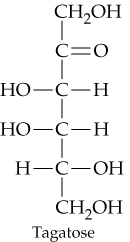
Classify the four carbohydrates (a)–(d) by indicating the nature of the carbonyl group and the number of carbon atoms present. For example, glucose is an aldohexose.
d. Structural formula of Tagatose, showing its carbonyl group and carbon atom arrangement.

Verified step by step guidance
1
Step 1: Understand the classification of carbohydrates. Carbohydrates are classified based on two main criteria: (1) the type of carbonyl group present (aldehyde or ketone), and (2) the number of carbon atoms in the molecule. For example, an 'aldohexose' is a carbohydrate with an aldehyde group and six carbon atoms.
Step 2: Examine the structure of each carbohydrate provided in the problem. Look for the functional group that contains the carbonyl (C=O). If the carbonyl group is at the end of the chain, it is an aldehyde, and the carbohydrate is classified as an 'aldo-'. If the carbonyl group is within the chain, it is a ketone, and the carbohydrate is classified as a 'keto-'.
Step 3: Count the number of carbon atoms in the structure of each carbohydrate. This will determine the suffix of the classification. For example, 3 carbons = triose, 4 carbons = tetrose, 5 carbons = pentose, and 6 carbons = hexose.
Step 4: Combine the information from Steps 2 and 3 to classify each carbohydrate. For example, if a carbohydrate has an aldehyde group and six carbon atoms, it is an aldohexose. If it has a ketone group and five carbon atoms, it is a ketopentose.
Step 5: Repeat the process for all four carbohydrates (a)–(d) provided in the problem. Carefully analyze each structure to determine the nature of the carbonyl group and the number of carbon atoms, then assign the appropriate classification.

Verified video answer for a similar problem:

This video solution was recommended by our tutors as helpful for the problem above.
Video duration:
1m
Was this helpful?

Key Concepts

Here are the essential concepts you must grasp in order to answer the question correctly.

Carbonyl Group

The carbonyl group is a functional group characterized by a carbon atom double-bonded to an oxygen atom (C=O). In carbohydrates, the nature of the carbonyl group determines whether the sugar is classified as an aldose (with an aldehyde group at the end of the carbon chain) or a ketose (with a ketone group within the carbon chain). This classification is essential for identifying the type of carbohydrate.
Recommended video:
Guided course
1:00
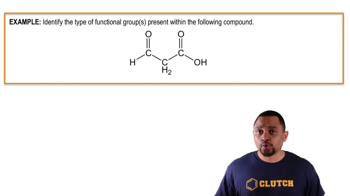
Functional Groups with Carbonyls Example 3

Number of Carbon Atoms

The number of carbon atoms in a carbohydrate is crucial for its classification. Carbohydrates are often categorized based on the number of carbon atoms they contain, such as triose (3), tetrose (4), pentose (5), hexose (6), and so on. This classification helps in understanding the structure and function of the carbohydrate, as different carbon counts can lead to different properties and biological roles.
Recommended video:
Guided course
5:36
Amino Acid Catabolism: Carbon Atoms Concept 2

Carbohydrate Classification

Carbohydrates are classified into simple sugars (monosaccharides) and complex carbohydrates (oligosaccharides and polysaccharides). Monosaccharides can be further classified based on the type of carbonyl group and the number of carbon atoms. Understanding this classification is essential for analyzing the structure and reactivity of carbohydrates, as well as their roles in biological systems.
Recommended video:
Guided course
1:29
Classification of Carbohydrates Example 1