Pearson+ LogoPearson+ Logo
Ch.16 Amines
McMurry - Fundamentals of GOB 8th Edition
McMurry8th EditionFundamentals of GOBISBN: 9780134015187Not the one you use?Change textbook
Chapter 16, Problem 24b

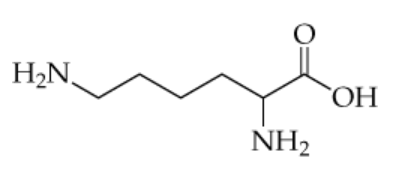
The structure of the amino acid lysine (in its uncharged form) is shown below.
Structure of the amino acid lysine in its uncharged form, showing functional groups and molecular connections.
b. Is lysine likely to be water-soluble? Explain.

Verified step by step guidance
1
Step 1: Understand the structure of lysine. Lysine is an amino acid with a side chain containing an amino group (-NH2) attached to a long hydrocarbon chain. It also has the general structure of amino acids, which includes an amino group (-NH2), a carboxyl group (-COOH), and a central carbon atom bonded to a hydrogen atom and the side chain.
Step 2: Recall the concept of solubility. A molecule's solubility in water depends on its ability to form hydrogen bonds with water molecules. Polar or charged groups in a molecule increase its water solubility because they can interact with water's polar nature.
Step 3: Analyze the functional groups in lysine. Lysine contains polar functional groups, such as the amino group (-NH2) and the carboxyl group (-COOH), which can form hydrogen bonds with water. Additionally, the side chain of lysine has another amino group (-NH2), which is also polar and capable of hydrogen bonding.
Step 4: Consider the overall polarity of lysine. Despite the presence of a hydrocarbon chain in the side chain, the multiple polar groups dominate, making lysine a polar molecule overall. This polarity enhances its interaction with water.
Step 5: Conclude based on the analysis. Since lysine has several polar groups capable of forming hydrogen bonds with water, it is likely to be water-soluble. The presence of these groups outweighs the nonpolar hydrocarbon chain in the side chain.

Verified video answer for a similar problem:

This video solution was recommended by our tutors as helpful for the problem above.
Was this helpful?

Key Concepts

Here are the essential concepts you must grasp in order to answer the question correctly.

Amino Acid Structure

Amino acids are organic compounds composed of an amino group, a carboxyl group, and a unique side chain (R group). The structure of lysine includes a positively charged amino group in its side chain, which influences its interactions with water and other molecules. Understanding the basic structure of amino acids is essential for predicting their solubility and behavior in biological systems.
Recommended video:
Guided course
3:03
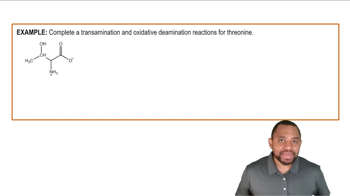
Amino Acid Catabolism: Amino Group Example 2

Polarity and Solubility

Polarity refers to the distribution of electrical charge around atoms, molecules, or chemical groups. Water is a polar solvent, meaning it dissolves other polar substances well. Lysine, with its polar amino and carboxyl groups, is likely to interact favorably with water, making it water-soluble. This concept is crucial for understanding how amino acids behave in aqueous environments.
Recommended video:
Guided course
01:34
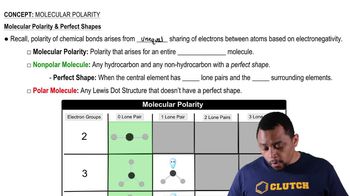
Molecular Polarity (Simplified) Concept 1

Hydrophilic vs. Hydrophobic

Hydrophilic molecules are attracted to water and tend to dissolve in it, while hydrophobic molecules repel water and do not dissolve easily. Lysine, due to its polar side chain and functional groups, is classified as hydrophilic. This classification helps explain why lysine is likely to be water-soluble, as hydrophilic substances readily interact with the polar nature of water.
Recommended video:
Guided course
3:33
Enantiomers vs Diastereomers Concept 1