Pearson+ LogoPearson+ Logo
Ch.12 Introduction to Organic Chemistry: Alkanes
McMurry - Fundamentals of GOB 8th Edition
McMurry8th EditionFundamentals of GOBISBN: 9780134015187Not the one you use?Change textbook
Chapter 12, Problem 7b

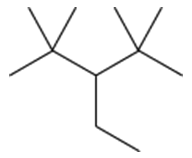
Convert the following line structures to condensed structures:
b.

Verified step by step guidance
1
Identify the number of carbon atoms in the main chain of the line structure. Each vertex or endpoint in the line structure represents a carbon atom.
Determine the number of hydrogen atoms attached to each carbon atom. Remember that carbon forms four bonds in total, so subtract the number of bonds already shown in the structure from four to find the number of hydrogens.
Write the condensed structure for each carbon atom, starting from one end of the chain and moving to the other. Represent each carbon atom as 'C' followed by the number of hydrogens attached (e.g., CH3, CH2, CH).
Include any branches or substituents in the structure. For branches, identify the carbon they are attached to and write them in parentheses after the main chain carbon they are connected to.
Combine all the condensed representations into a single condensed structure, ensuring the order matches the connectivity of the original line structure.

Verified video answer for a similar problem:

This video solution was recommended by our tutors as helpful for the problem above.
Video duration:
2m
Was this helpful?

Key Concepts

Here are the essential concepts you must grasp in order to answer the question correctly.

Line Structures

Line structures refer to the graphical representation of data or information, often used in diagrams or flowcharts. They illustrate relationships, processes, or hierarchies in a visual format, making complex information easier to understand. In the context of the question, these structures likely represent a sequence or a set of components that need to be simplified.
Recommended video:
Guided course
01:59
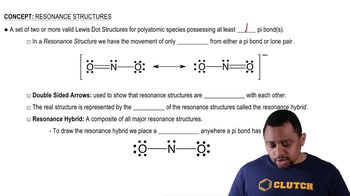
Resonance Structures (Simplified) Concept 1

Condensed Structures

Condensed structures are simplified versions of original line structures that maintain essential information while reducing complexity. This process involves removing extraneous details and focusing on core elements, which can enhance clarity and facilitate quicker comprehension. In practice, this might involve using symbols or abbreviations to represent larger concepts.
Recommended video:
Guided course
1:53
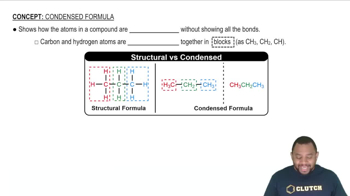
Condensed Formula Concept 1

Data Visualization

Data visualization is the graphical representation of information and data, which helps to communicate complex data clearly and efficiently. It employs visual elements like charts, graphs, and maps to present data trends and patterns. Understanding data visualization is crucial for converting line structures into condensed forms, as it emphasizes the importance of clarity and accessibility in presenting information.
Recommended video:
Guided course
00:35
The Scientific Method Example 2