Pearson+ LogoPearson+ Logo
Ch.12 Introduction to Organic Chemistry: Alkanes
McMurry - Fundamentals of GOB 8th Edition
McMurry8th EditionFundamentals of GOBISBN: 9780134015187Not the one you use?Change textbook
Chapter 12, Problem 5b

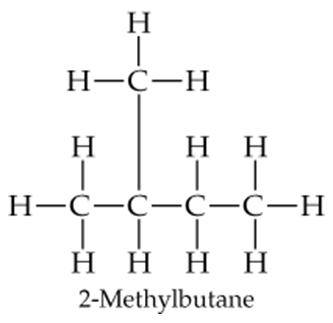
Draw the following three isomers of C5H12 as condensed structures:
b.

Verified step by step guidance
1
Step 1: Understand the concept of isomers. Isomers are compounds with the same molecular formula but different structural arrangements. For C₅H₁₂, the molecular formula represents an alkane (saturated hydrocarbon). The three isomers will differ in how the carbon atoms are connected.
Step 2: Identify the possible structural arrangements for C₅H₁₂. Start with the straight-chain structure (n-pentane), where all five carbon atoms are connected in a single continuous chain. Write this as a condensed structure: CH₃-CH₂-CH₂-CH₂-CH₃.
Step 3: Create a branched isomer by moving one of the terminal carbon atoms to form a branch. This results in isobutane (2-methylbutane). Write the condensed structure as: CH₃-CH(CH₃)-CH₂-CH₃.
Step 4: Create another branched isomer by moving two terminal carbon atoms to form a more compact structure. This results in neopentane (2,2-dimethylpropane). Write the condensed structure as: CH₃-C(CH₃)₂-CH₃.
Step 5: Verify that all three structures have the molecular formula C₅H₁₂ and that they are unique. Ensure that each structure adheres to the rules of valency for carbon (each carbon atom forms four bonds) and hydrogen.

Verified video answer for a similar problem:

This video solution was recommended by our tutors as helpful for the problem above.
Was this helpful?

Key Concepts

Here are the essential concepts you must grasp in order to answer the question correctly.

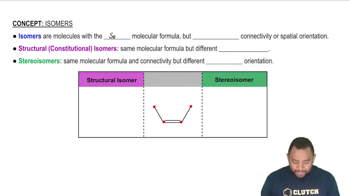
Isomers

Isomers are compounds that have the same molecular formula but different structural arrangements of atoms. This can lead to variations in physical and chemical properties. In the case of C₅H₁₂, there are several structural isomers, including straight-chain and branched forms, which must be accurately represented in condensed structural formulas.
Recommended video:
Guided course
2:16
Isomers Concept 1

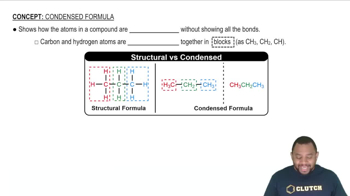
Condensed Structures

Condensed structures are a way of representing the molecular structure of a compound in a simplified format. They show the connectivity of atoms without depicting all the bonds explicitly. For example, in a condensed structure, the carbon atoms and their attached hydrogen atoms are grouped together, making it easier to visualize the arrangement of atoms in isomers.
Recommended video:
Guided course
1:53
Condensed Formula Concept 1

C₅H₁₂ (Pentane)

C₅H₁₂, commonly known as pentane, is an alkane with five carbon atoms. It serves as a fundamental example in organic chemistry for studying isomerism. The three main isomers of pentane include n-pentane (a straight chain), isopentane (a branched chain), and neopentane (a more compact branched structure), each with distinct properties and applications.
Recommended video:
Guided course
1:36
Phase C - Oxaloacetate Regeneration Concept 7