Pearson+ LogoPearson+ Logo
Ch.23 Lipids
McMurry - Fundamentals of GOB 8th Edition
McMurry8th EditionFundamentals of GOBISBN: 9780134015187Not the one you use?Change textbook
Chapter 23, Problem 16e

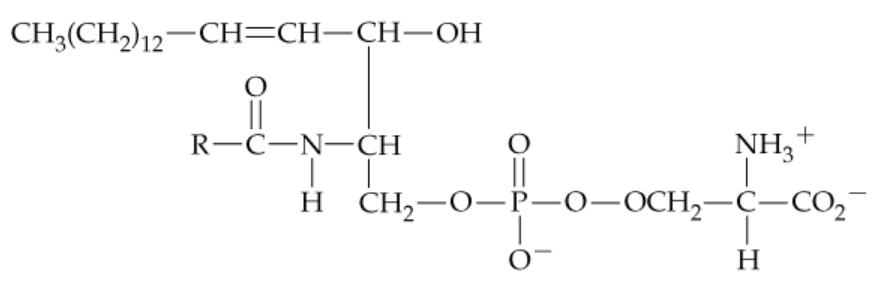
Which of the following terms apply to the compound shown below? (Hint: Look at the functional groups and the bonds involved to begin analyzing the compound part by part in comparison to the lipids discussed in this chapter.)
Chemical structure of a triacylglycerol, highlighting functional groups and bonds for lipid analysis.
e. A lipid

Verified step by step guidance
1
Examine the structure of the compound in the image provided. Identify the key functional groups present, such as hydroxyl (-OH), carboxyl (-COOH), ester (-COOR), or long hydrocarbon chains, as these are common in lipids.
Determine if the compound contains long hydrophobic (nonpolar) hydrocarbon chains, which are characteristic of lipids like fatty acids, triglycerides, or phospholipids.
Check for the presence of ester bonds (-COOR), which are typically found in triglycerides and phospholipids, formed by the reaction of fatty acids with glycerol or other alcohols.
Analyze whether the compound has a polar head group and nonpolar tail regions, a structural feature of amphipathic lipids such as phospholipids.
Compare the identified features of the compound to the general characteristics of lipids discussed in the chapter to determine if the term 'lipid' applies to the compound.

Verified video answer for a similar problem:

This video solution was recommended by our tutors as helpful for the problem above.
Video duration:
1m
Was this helpful?

Key Concepts

Here are the essential concepts you must grasp in order to answer the question correctly.

Functional Groups

Functional groups are specific groups of atoms within molecules that are responsible for the characteristic chemical reactions of those molecules. In the context of lipids, common functional groups include hydroxyl (-OH), carboxyl (-COOH), and phosphate (-PO4). Identifying these groups helps in determining the properties and classification of the compound.
Recommended video:
Guided course
1:11
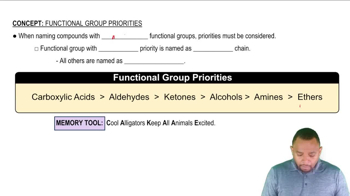
Functional Group Priorities Concept 1

Lipids

Lipids are a diverse group of hydrophobic organic compounds, including fats, oils, and phospholipids, that are primarily composed of carbon and hydrogen. They play crucial roles in biological systems, such as energy storage, membrane structure, and signaling. Understanding the structure and function of lipids is essential for analyzing compounds in relation to biological processes.
Recommended video:
Guided course
1:28
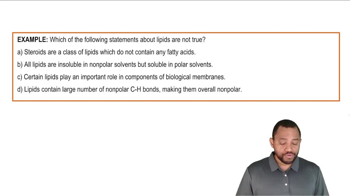
Intro to Lipids Example 1

Chemical Bonds

Chemical bonds, including covalent and ionic bonds, are the forces that hold atoms together in a molecule. The type and arrangement of these bonds influence the stability and reactivity of the compound. In the analysis of lipids, recognizing the types of bonds present can help determine the compound's classification and its interactions with other biological molecules.
Recommended video:
Guided course
00:49
Chemical Reaction: Chemical Change Example 1