Pearson+ LogoPearson+ Logo
Ch.23 Lipids
McMurry - Fundamentals of GOB 8th Edition
McMurry8th EditionFundamentals of GOBISBN: 9780134015187Not the one you use?Change textbook
Chapter 23, Problem 75a

Based on the information in Section 23.7, how would you expect each of these common metabolites to cross the cell membrane?
a. CO

Verified step by step guidance
1
Understand the nature of the molecule: Carbon monoxide (CO) is a small, nonpolar molecule. Nonpolar molecules can typically diffuse across the lipid bilayer of the cell membrane without the need for transport proteins.
Recall the structure of the cell membrane: The cell membrane is composed of a phospholipid bilayer with hydrophobic (nonpolar) tails facing inward and hydrophilic (polar) heads facing outward. Nonpolar molecules like CO can pass through the hydrophobic core of the membrane.
Apply the principle of simple diffusion: Small, nonpolar molecules such as CO can cross the cell membrane via simple diffusion, which does not require energy or assistance from membrane proteins.
Consider the driving force for diffusion: The movement of CO across the membrane will depend on the concentration gradient. CO will diffuse from an area of higher concentration to an area of lower concentration until equilibrium is reached.
Summarize the process: CO crosses the cell membrane by simple diffusion due to its small size and nonpolar nature, moving along its concentration gradient without the need for energy or transport proteins.

Verified video answer for a similar problem:

This video solution was recommended by our tutors as helpful for the problem above.
Video duration:
2m
Was this helpful?

Key Concepts

Here are the essential concepts you must grasp in order to answer the question correctly.

Cell Membrane Structure

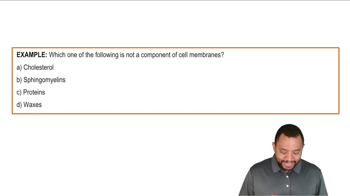
The cell membrane is primarily composed of a phospholipid bilayer, which creates a semi-permeable barrier. This structure allows certain molecules to pass through while restricting others based on size, polarity, and charge. Understanding this structure is crucial for predicting how different metabolites, like CO, can traverse the membrane.
Recommended video:
Guided course
1:00
Cell Membranes Example 1

Diffusion

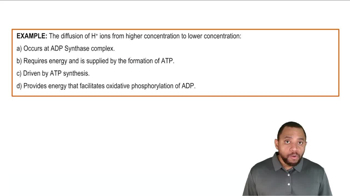
Diffusion is the process by which molecules move from an area of higher concentration to an area of lower concentration. Small, nonpolar molecules, such as carbon monoxide (CO), can easily diffuse across the lipid bilayer of the cell membrane without the need for transport proteins, making this concept essential for understanding CO's movement.
Recommended video:
Guided course
1:23
Oxidative Phosphorylation Example 1

Transport Mechanisms

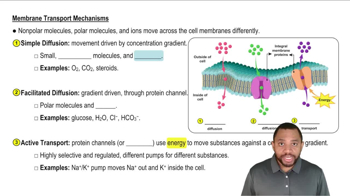
Transport mechanisms refer to the various ways substances can cross the cell membrane, including passive transport (like diffusion) and active transport. While CO can diffuse passively, understanding other transport mechanisms is important for comparing how different metabolites might cross the membrane under various conditions.
Recommended video:
Guided course
3:01
Membrane Transport Concept 2