Pearson+ LogoPearson+ Logo
Ch.18 Amino Acids and Proteins
McMurry - Fundamentals of GOB 8th Edition
McMurry8th EditionFundamentals of GOBISBN: 9780134015187Not the one you use?Change textbook
Chapter 18, Problem 76b

What kind of bond would you expect between the side chains of the following amino acids?
b. Alanine and leucine

Verified step by step guidance
1
Identify the side chains of the given amino acids: Alanine has a nonpolar methyl group (-CH3) as its side chain, and leucine has a larger nonpolar isobutyl group (-CH2-CH-(CH3)2) as its side chain.
Recognize that both side chains are nonpolar and hydrophobic in nature, meaning they do not interact favorably with water.
Understand that nonpolar side chains tend to interact with each other through hydrophobic interactions, which are a type of weak intermolecular force.
Conclude that the bond or interaction expected between the side chains of alanine and leucine is a hydrophobic interaction, as both side chains are nonpolar and will cluster together to avoid water.
Note that these hydrophobic interactions are important in stabilizing the tertiary structure of proteins by helping nonpolar side chains aggregate in the protein's interior.

Verified video answer for a similar problem:

This video solution was recommended by our tutors as helpful for the problem above.
Was this helpful?

Key Concepts

Here are the essential concepts you must grasp in order to answer the question correctly.

Hydrophobic Interactions

Hydrophobic interactions occur between nonpolar side chains of amino acids, such as alanine and leucine. These interactions are driven by the tendency of nonpolar molecules to avoid water, leading them to cluster together in an aqueous environment. This clustering stabilizes protein structures and influences their folding.
Recommended video:
Guided course
2:41
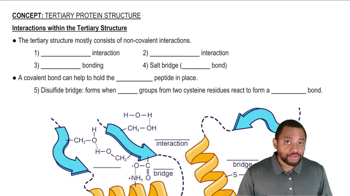
Interactions within the Tertiary Structure Concept 2

Amino Acid Side Chains

Amino acids have unique side chains (R groups) that determine their chemical properties. Alanine has a small, nonpolar side chain (methyl group), while leucine has a larger, branched nonpolar side chain. The nature of these side chains affects how amino acids interact with each other and with their environment.
Recommended video:
Guided course
3:04
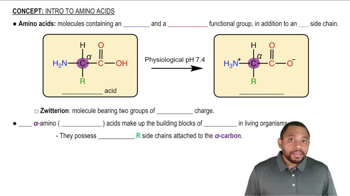
Intro to Amino Acids Concept 1

Protein Structure

The structure of proteins is influenced by the interactions between amino acid side chains. These interactions can lead to various levels of protein structure, including primary, secondary, tertiary, and quaternary structures. Understanding how side chains like those of alanine and leucine interact is crucial for predicting protein folding and function.
Recommended video:
Guided course
3:26
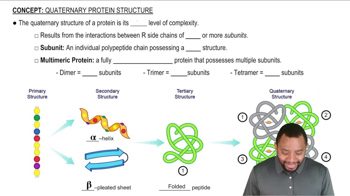
Quaternary Protein Structure Concept 1