Pearson+ LogoPearson+ Logo
Ch.18 Amino Acids and Proteins
McMurry - Fundamentals of GOB 8th Edition
McMurry8th EditionFundamentals of GOBISBN: 9780134015187Not the one you use?Change textbook
Chapter 18, Problem 30a

For each of the conjugated proteins described, identify to which class of conjugated protein it belongs.
a. Cholesterol is attached to this protein in order to move through the blood system.

Verified step by step guidance
1
Step 1: Understand the concept of conjugated proteins. Conjugated proteins are proteins that are combined with a non-protein component, called a prosthetic group. The type of prosthetic group determines the class of the conjugated protein.
Step 2: Identify the prosthetic group in the given problem. In this case, cholesterol is attached to the protein. Cholesterol is a lipid molecule.
Step 3: Recall the classification of conjugated proteins. Proteins are classified based on their prosthetic group. For example, lipoproteins have lipids as their prosthetic group, glycoproteins have carbohydrates, and metalloproteins have metal ions.
Step 4: Match the prosthetic group (cholesterol, a lipid) to the appropriate class of conjugated protein. Since cholesterol is a lipid, the protein belongs to the class of lipoproteins.
Step 5: Conclude that the protein described in the problem is a lipoprotein, as it has cholesterol (a lipid) attached to it to facilitate its movement through the blood system.

Verified video answer for a similar problem:

This video solution was recommended by our tutors as helpful for the problem above.
Was this helpful?

Key Concepts

Here are the essential concepts you must grasp in order to answer the question correctly.

Conjugated Proteins

Conjugated proteins are proteins that are covalently bonded to a non-protein group, known as a prosthetic group. These groups can be carbohydrates, lipids, or metal ions, and they play a crucial role in the protein's function. Understanding the nature of these attachments is essential for classifying the protein and determining its biological role.
Recommended video:
Guided course
2:01
Digestion of Proteins Concept 1

Lipoproteins

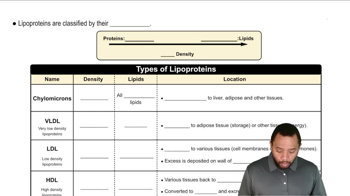
Lipoproteins are a class of conjugated proteins that consist of proteins and lipids, such as cholesterol. They are essential for transporting lipids through the bloodstream, as lipids are not soluble in water. The classification of lipoproteins is based on their density and composition, which influences their function in lipid metabolism and cardiovascular health.
Recommended video:
Guided course
3:52
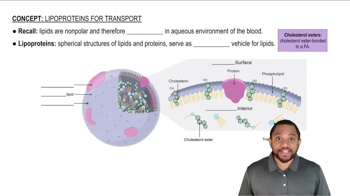
Lipoproteins for Transport Concept 2

Cholesterol Transport

Cholesterol transport refers to the mechanisms by which cholesterol is moved through the bloodstream, primarily via lipoproteins. This process is vital for maintaining cellular function and membrane integrity. Understanding how cholesterol is conjugated to proteins helps in identifying the specific class of conjugated protein involved in its transport, such as low-density lipoproteins (LDL) or high-density lipoproteins (HDL).
Recommended video:
Guided course
1:39
Lipoproteins for Transport Concept 1