Pearson+ LogoPearson+ Logo
Ch.13 Alkenes, Alkynes, and Aromatic Compounds
McMurry - Fundamentals of GOB 8th Edition
McMurry8th EditionFundamentals of GOBISBN: 9780134015187Not the one you use?Change textbook
Chapter 13, Problem 2

Draw both condensed and line structures corresponding to the following IUPAC names:
a. 3-Methyl-1-heptene
b. 4,4-Dimethyl-2-pentyne
c. 2-Methyl-3-hexene
d. 1,3,3-Trimethylcyclohexene

Verified step by step guidance
1
Step 1: Understand the IUPAC naming conventions. For each compound, identify the main chain, the position of double or triple bonds, and the substituents. This will guide the drawing of both condensed and line structures.
Step 2: For 3-Methyl-1-heptene: Start with a 7-carbon chain (heptene) with a double bond at position 1. Add a methyl group (CH₃) at position 3. Draw the condensed structure by writing out each group explicitly (e.g., CH₃-CH=CH-...). For the line structure, represent the main chain as a zigzag line with the double bond and methyl group clearly indicated.
Step 3: For 4,4-Dimethyl-2-pentyne: Begin with a 5-carbon chain (pentyne) with a triple bond at position 2. Add two methyl groups (CH₃) at position 4. Draw the condensed structure by explicitly showing each group (e.g., CH₃-C≡C-...). For the line structure, use a zigzag line with the triple bond and methyl groups clearly marked.
Step 4: For 2-Methyl-3-hexene: Start with a 6-carbon chain (hexene) with a double bond at position 3. Add a methyl group (CH₃) at position 2. Draw the condensed structure by writing out each group explicitly (e.g., CH₃-CH(CH₃)-CH=...). For the line structure, represent the main chain as a zigzag line with the double bond and methyl group clearly indicated.
Step 5: For 1,3,3-Trimethylcyclohexene: Begin with a cyclohexene ring (6-membered ring with a double bond). Add three methyl groups (CH₃): one at position 1 and two at position 3. Draw the condensed structure by explicitly showing the ring and substituents (e.g., CH₂=C(CH₃)-...). For the line structure, represent the ring as a hexagon with the double bond and methyl groups clearly marked.

Verified video answer for a similar problem:

This video solution was recommended by our tutors as helpful for the problem above.
Was this helpful?

Key Concepts

Here are the essential concepts you must grasp in order to answer the question correctly.

IUPAC Nomenclature

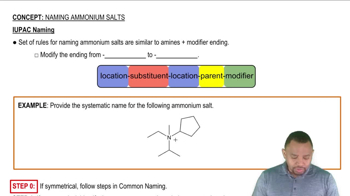
IUPAC nomenclature is a systematic method for naming chemical compounds. It provides a set of rules to derive names based on the structure of the molecule, including the longest carbon chain, functional groups, and substituents. Understanding these rules is essential for accurately interpreting and drawing the structures of organic compounds.
Recommended video:
Guided course
3:18
IUPAC Naming Concept 3

Condensed Structures

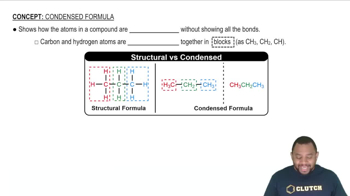
Condensed structures are a simplified way of representing molecular structures where atoms are grouped together to show connectivity without depicting all bonds explicitly. In these structures, carbon atoms and their attached hydrogens are often written in a linear format, making it easier to visualize the molecular framework without drawing every bond.
Recommended video:
Guided course
1:53
Condensed Formula Concept 1

Line Structures

Line structures, also known as skeletal structures, are a representation of organic molecules where carbon atoms are represented by vertices and lines indicate bonds. This format omits hydrogen atoms attached to carbons, simplifying the drawing and focusing on the connectivity and arrangement of the carbon skeleton and functional groups, which is crucial for understanding the compound's reactivity and properties.
Recommended video:
Guided course
01:59
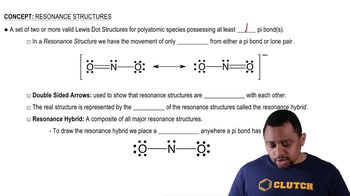
Resonance Structures (Simplified) Concept 1