Back
Back Sanders 3rd EditionCh. 20 - Population Genetics and Evolution at the Population, Species, and Molecular Levels
Problem D.13
When the human genome is examined, the chromosomes appear to have undergone only minimal rearrangement in the 100 million years since the last common ancestor of eutherian mammals. However, when individual humans are examined or when the human genome is compared with that of chimpanzees, a large number of small indels and SNPs can be detected. How are these observations reconciled?
Problem E.13
Look over the 10 diseases approved for genetic health risk assessment listed in Application Chapter B. Select one disease other than the three discussed in Application Chapter B or in this chapter (alpha-1 antitrypsin deficiency, late-onset Alzheimer disease, and celiac disease) or another of the diseases of your choice. Do a brief Internet search to find and download (1) one article for a nonscientific audience identifying the gene or genes whose alleles are associated with occurrence of the disease and (2) one scientific paper that provides data supporting the association of specific alleles of the gene or genes with the disease. Write a short summary combining the information contained in the two papers.
Problem 13a
Two populations of deer, one of them large and living in a mainland forest and the other small and inhabiting a forest on an island, regularly exchange members that migrate across a land bridge that connects the island to the mainland. If you compared the allele frequencies in the two populations, what would you expect to find?
Problem 13b
Two populations of deer, one of them large and living in a mainland forest and the other small and inhabiting a forest on an island, regularly exchange members that migrate across a land bridge that connects the island to the mainland. An earthquake destroys the bridge between the island and the mainland, making migration impossible for the deer. What do you expect will happen to allele frequencies in the two populations over the following 10 generations?
Problem 13c
Two populations of deer, one of them large and living in a mainland forest and the other small and inhabiting a forest on an island, regularly exchange members that migrate across a land bridge that connects the island to the mainland. In which population do you expect to see the greatest allele frequency change? Why?
- Directional selection presents an apparent paradox. By favoring one allele and disfavoring others, directional selection can lead to fixation (a frequency of 1.0) of the favored allele, after which there is no genetic variation at the locus, and its evolution stops. Explain why directional selection no longer operates in populations after the favored allele reaches fixation.
Problem 14
Problem D.14
The mtDNA sequence of Neanderthals is more similar to that of modern humans than to that of Denisovans. However, analyses of nuclear DNA clearly indicate that Neandertals and Denisovans share a more recent common ancestor than either of these hominins shares with modern humans. Propose a hypothesis to resolve the discrepancy between the mtDNA and the nuclear genome.
- What is inbreeding depression? Why is inbreeding depression a serious concern for animal biologists involved in species-conservation breeding programs?
Problem 15
Problem D.15
If you were to compare your genome sequence with that of your parents, how would it differ? If you were to compare your genome sequence with another student's in the class, how would it differ? What additional difference might you see if your genome was compared with that of a sub-Saharan African, or if you are of sub-Saharan African descent, with that of a non-African?
Problem 16
Certain animal species, such as the black-footed ferret, are nearly extinct and currently exist only in captive populations. Other species, such as the panda, are also threatened but exist in the wild thanks to intensive captive breeding programs. What strategies would you suggest in the case of black-footed ferrets and in the case of pandas to monitor and minimize inbreeding depression?
Problem 17
Genetic Analysis 20.1 predicts the number of individuals expected to have the blood group genotypes MM, MN, and NN. Perform a chi-square analysis using the number of people observed and expected in each blood-type category, and state whether the sample is in H-W equilibrium.
Problem 18
In a population of rabbits, f(C₁) = 0.70 and f(C₂) = 0.30. The alleles exhibit an incomplete dominance relationship in which C₁C₁ produces black rabbits, C₁C₂ produces tan-colored rabbits, and C₂C₂ produces rabbits with white fur. If the assumptions of the Hardy–Weinberg principle apply to the rabbit population, what are the expected frequencies of black, tan, and white rabbits?
Problem 19a
Sickle cell disease (SCD) is found in numerous populations whose ancestral homes are in the malaria belt of Africa and Asia. SCD is an autosomal recessive disorder that results from homozygosity for a mutant β-globin gene allele. Data on one affected population indicates that approximately 8 in 100 newborn infants have SCD.
What are the frequencies of the wild-type (βᴬ) and mutant (βˢ) alleles in this population?
Problem 19b
Sickle cell disease (SCD) is found in numerous populations whose ancestral homes are in the malaria belt of Africa and Asia. SCD is an autosomal recessive disorder that results from homozygosity for a mutant β-globin gene allele. Data on one affected population indicates that approximately 8 in 100 newborn infants have SCD.
What is the frequency of carriers of SCD in the population?
Problem 20
Epidemiologic data on the population in the previous problem reveal that before the application of modern medical treatment, natural selection played a major role in shaping the frequencies of alleles. Heterozygous individuals have the highest relative fitness, and in comparison with heterozygotes, those who are βᴬβᴬ have a relative fitness of 82%, but only about 32% of those with SCD survived to reproduce. What are the estimated equilibrium frequencies of βᴬ and βˢ in this population?
Problem 21a
The frequency of tasters and nontasters of PTC varies among populations. In population A, 64% of people are tasters (an autosomal dominant trait) and 36% are nontasters. In population B, tasters are 75% and nontasters 25%. In population C, tasters are 91% and nontasters are 9%.
Calculate the frequency of the dominant (T) allele for PTC tasting and the recessive (t) allele for nontasting in each population.
Problem 21b
The frequency of tasters and nontasters of PTC varies among populations. In population A, 64% of people are tasters (an autosomal dominant trait) and 36% are nontasters. In population B, tasters are 75% and nontasters 25%. In population C, tasters are 91% and nontasters are 9%.
Assuming that Hardy–Weinberg conditions apply, determine the genotype frequencies in each population.
Problem 22a
Tay–Sachs disease is an autosomal recessive neurological disorder that is fatal in infancy. Despite its invariably lethal effect, Tay–Sachs disease occurs at very high frequency in some Central and Eastern European (Ashkenazi) Jewish populations. In certain Ashkenazi populations, 1 in 750 infants has Tay–Sachs disease. Population biologists believe the high frequency is a consequence of genetic bottlenecks caused by pogroms (genocide) that have reduced the population multiple times in the past several hundred years. What is a genetic bottleneck?
Problem 22b
Tay–Sachs disease is an autosomal recessive neurological disorder that is fatal in infancy. Despite its invariably lethal effect, Tay–Sachs disease occurs at very high frequency in some Central and Eastern European (Ashkenazi) Jewish populations. In certain Ashkenazi populations, 1 in 750 infants has Tay–Sachs disease. Population biologists believe the high frequency is a consequence of genetic bottlenecks caused by pogroms (genocide) that have reduced the population multiple times in the past several hundred years. Explain how a genetic bottleneck and its aftermath could result in a population that carries a lethal allele in high frequency.
Problem 22c
Tay–Sachs disease is an autosomal recessive neurological disorder that is fatal in infancy. Despite its invariably lethal effect, Tay–Sachs disease occurs at very high frequency in some Central and Eastern European (Ashkenazi) Jewish populations. In certain Ashkenazi populations, 1 in 750 infants has Tay–Sachs disease. Population biologists believe the high frequency is a consequence of genetic bottlenecks caused by pogroms (genocide) that have reduced the population multiple times in the past several hundred years. In the population described, what is the frequency of the recessive allele that produces Tay–Sachs disease?
Problem 22d
Tay–Sachs disease is an autosomal recessive neurological disorder that is fatal in infancy. Despite its invariably lethal effect, Tay–Sachs disease occurs at very high frequency in some Central and Eastern European (Ashkenazi) Jewish populations. In certain Ashkenazi populations, 1 in 750 infants has Tay–Sachs disease. Population biologists believe the high frequency is a consequence of genetic bottlenecks caused by pogroms (genocide) that have reduced the population multiple times in the past several hundred years. Assuming mating occurs at random in this population, what is the probability a couple are both carriers of Tay–Sachs disease?
- Cystic fibrosis (CF) is the most common autosomal recessive disorder in certain Caucasian populations. In some populations, approximately 1 in 2000 children have CF. Determine the frequency of CF carriers in this population.
Problem 23
Problem 24a
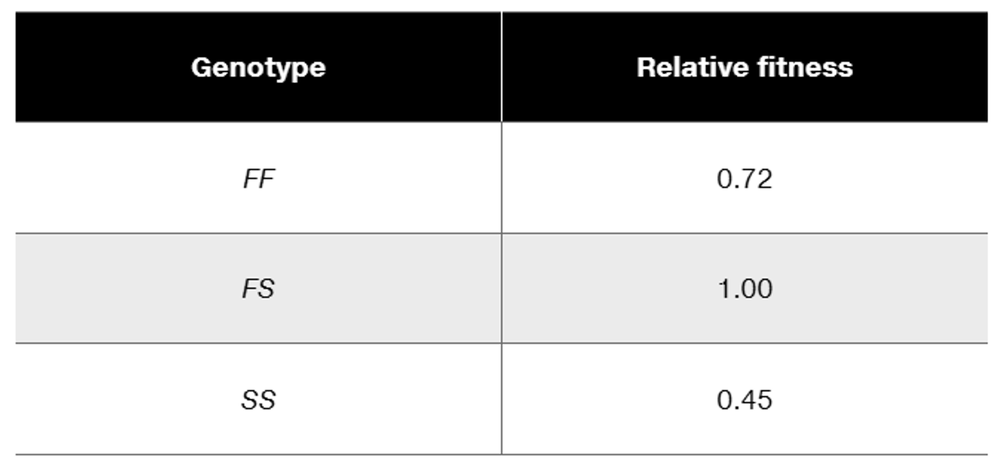
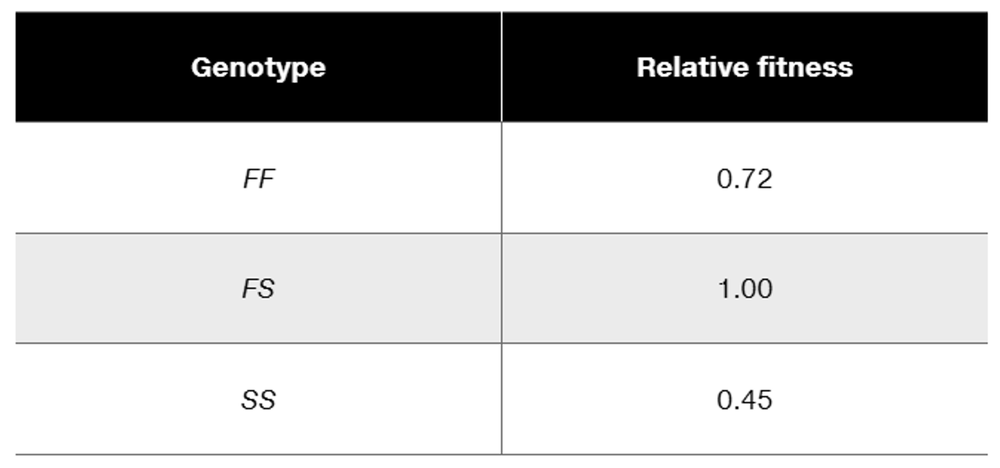
In the mouse, Mus musculus, survival in agricultural fields that are regularly sprayed with a herbicide is determined by the genotype for a detoxification enzyme encoded by a gene with two alleles, F and S. The relative fitness values for the genotypes are
Why will this pattern of natural selection result in a stable equilibrium of frequencies of F and S?
Problem 24b
In the mouse, Mus musculus, survival in agricultural fields that are regularly sprayed with a herbicide is determined by the genotype for a detoxification enzyme encoded by a gene with two alleles, F and S. The relative fitness values for the genotypes are
Calculate the equilibrium frequencies of the alleles.
Problem 25a
In a population of flowers growing in a meadow, C1 and C2 are autosomal codominant alleles that control flower color. The alleles are polymorphic in the population, with f(C1) = 0.80 and f(C2) = 0.20. Flowers that are C1C1 are yellow, orange flowers are C1C2, and C2C2 flowers are red. A storm blows a new species of hungry insects into the meadow, and they begin to eat yellow and orange flowers but not red flowers. The predation exerts strong natural selection on the flower population, resulting in relative fitness values of C1C1 = 0.30, C1C2 = 0.60, and C2C2 = 1.0.
Assuming the population begins in H-W equilibrium, what are the allele frequencies after one generation of natural selection?
Problem 25b
In a population of flowers growing in a meadow, C1 and C2 are autosomal codominant alleles that control flower color. The alleles are polymorphic in the population, with f (C1) = 0.80 and f (C2) = 0.20. Flowers that are C1C1 are yellow, orange flowers are C1C2, and C2C2 flowers are red. A storm blows a new species of hungry insects into the meadow, and they begin to eat yellow and orange flowers but not red flowers. The predation exerts strong natural selection on the flower population, resulting in relative fitness values of C1C1 = 0.30, C1C2 = 0.60, and C2C2 = 1.0.
Assuming random mating takes place among survivors, what are the genotype frequencies in the second generation?
Problem 25c
In a population of flowers growing in a meadow, C1 and C2 are autosomal codominant alleles that control flower color. The alleles are polymorphic in the population, with f (C1) = 0.80 and f (C2) = 0.20. Flowers that are C1C1 are yellow, orange flowers are C1C2, and C2C2 flowers are red. A storm blows a new species of hungry insects into the meadow, and they begin to eat yellow and orange flowers but not red flowers. The predation exerts strong natural selection on the flower population, resulting in relative fitness values of C1C1 = 0.30, C1C2 = 0.60, and C2C2 = 1.0.
If predation continues, what are the allele frequencies when the second generation mates?
Problem 25d
In a population of flowers growing in a meadow, C1 and C2 are autosomal codominant alleles that control flower color. The alleles are polymorphic in the population, with f (C1) = 0.80 and f (C2) = 0.20. Flowers that are C1C1 are yellow, orange flowers are C1C2, and C2C2 flowers are red. A storm blows a new species of hungry insects into the meadow, and they begin to eat yellow and orange flowers but not red flowers. The predation exerts strong natural selection on the flower population, resulting in relative fitness values of C1C1 = 0.30, C1C2 = 0.60, and C2C2 = 1.0.
What are the equilibrium frequencies of C1 and C2 if predation continues?
Problem 26a
Assume that the flower population described in the previous problem undergoes a different pattern of predation. Flower-color determination and the starting frequencies of C₁ and C₂ are as described above, but the new insects attack yellow and red flowers, not orange flowers. As a result of the predation pattern, the relative fitness values are C₁C₁ = 0.40, C₁C₂ = 1.0, and C₂C₂ = 0.80.
What are the allele frequencies after one generation of natural selection?
Problem 26b
Assume that the flower population described in the previous problem undergoes a different pattern of predation. Flower-color determination and the starting frequencies of C₁ and C₂ are as described above, but the new insects attack yellow and red flowers, not orange flowers. As a result of the predation pattern, the relative fitness values are C₁C₁ = 0.40, C₁C₂ = 1.0, and C₂C₂ = 0.80.
What are the genotype frequencies among the progeny of predation survivors?