Back
Back Sanders 3rd EditionCh. 20 - Population Genetics and Evolution at the Population, Species, and Molecular Levels
Problem 26c
Assume that the flower population described in the previous problem undergoes a different pattern of predation. Flower-color determination and the starting frequencies of C₁ and C₂ are as described above, but the new insects attack yellow and red flowers, not orange flowers. As a result of the predation pattern, the relative fitness values are C₁C₁ = 0.40, C₁C₂ = 1.0, and C₂C₂ = 0.80.
What are the equilibrium allele frequencies in the predation environment?
Problem 27
ABO blood type is examined in a Taiwanese population, and allele frequencies are determined. In the population, f (Iᴬ) = 0.30, f (Iᴮ) = 0.15, and f (i) = 0.55.f. Assuming Hardy–Weinberg conditions apply, what are the frequencies of genotypes, and what are the blood group frequencies in this population?
- A total of 1000 members of a Central American population are typed for the ABO blood group. In the sample, 421 have blood type A, 168 have blood type B, 336 have blood type O, and 75 have blood type AB. Use this information to determine the frequency of ABO blood group alleles in the sample.
Problem 28
Problem 29a
A sample of 500 field mice contains 225 individuals that are D₁D₁, 175 that are D₁D₂, and 100 that are D₂D₂.
What are the frequencies of D₁ and D₂ in this sample?
Problem 29b
A sample of 500 field mice contains 225 individuals that are D₁D₁, 175 that are D₁D₂, and 100 that are D₂D₂.
Is this population in H-W equilibrium? Use the chi-square test to justify your answer.
Problem 29c
A sample of 500 field mice contains 225 individuals that are D₁D₁, 175 that are D₁D₂, and 100 that are D₂D₂.
Is inbreeding a possible genetic explanation for the observed distribution of genotypes? Why or why not?
Problem 30a
In humans the presence of chin and cheek dimples is dominant to the absence of dimples, and the ability to taste the compound PTC is dominant to the inability to taste the compound. Both traits are autosomal, and they are unlinked. The frequencies of alleles for dimples are D = 0.62 and d = 0.38. For tasting, the allele frequencies are T = 0.76 and t = 0.24.
Determine the frequency of genotypes for each gene and the frequency of each phenotype.
Problem 30b
In humans the presence of chin and cheek dimples is dominant to the absence of dimples, and the ability to taste the compound PTC is dominant to the inability to taste the compound. Both traits are autosomal, and they are unlinked. The frequencies of alleles for dimples are D = 0.62 and d = 0.38. For tasting, the allele frequencies are T = 0.76 and t = 0.24.
What are the expected frequencies of the four possible phenotype combinations: dimpled tasters, undimpled tasters, dimpled nontasters, and undimpled nontasters?
Problem 31a
Albinism, an autosomal recessive trait characterized by an absence of skin pigmentation, is found in 1 in 4000 people in populations at equilibrium. Brachydactyly, an autosomal dominant trait producing shortened fingers and toes, is found in 1 in 6000 people in populations at equilibrium. For each of these traits, calculate the frequency of the recessive allele at the locus
Problem 31b
Albinism, an autosomal recessive trait characterized by an absence of skin pigmentation, is found in 1 in 4000 people in populations at equilibrium. Brachydactyly, an autosomal dominant trait producing shortened fingers and toes, is found in 1 in 6000 people in populations at equilibrium. For each of these traits, calculate the frequency of the dominant allele at the locus
Problem 31c
Albinism, an autosomal recessive trait characterized by an absence of skin pigmentation, is found in 1 in 4000 people in populations at equilibrium. Brachydactyly, an autosomal dominant trait producing shortened fingers and toes, is found in 1 in 6000 people in populations at equilibrium. For each of these traits, calculate the frequency of heterozygotes in the population
Problem 31d
Albinism, an autosomal recessive trait characterized by an absence of skin pigmentation, is found in 1 in 4000 people in populations at equilibrium. Brachydactyly, an autosomal dominant trait producing shortened fingers and toes, is found in 1 in 6000 people in populations at equilibrium. For each of these traits, calculate the frequency of For albinism only, what is the frequency of mating between heterozygotes?
Problem 32a
The frequency of an autosomal recessive condition is 0.001 (1 in 1000) in a population.
What is the frequency of the mutant allele?
Problem 32b
The frequency of an autosomal recessive condition is 0.001 (1 in 1000) in a population.
What is the frequency of carriers of the mutant allele?
Problem 32c
The frequency of an autosomal recessive condition is 0.001 (1 in 1000) in a population.
Assuming individuals mate at random, what is the chance that two heterozygous individuals will mate?
Problem 33a
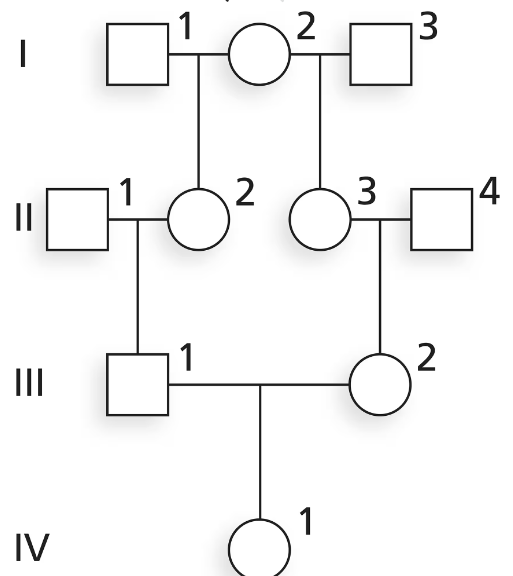
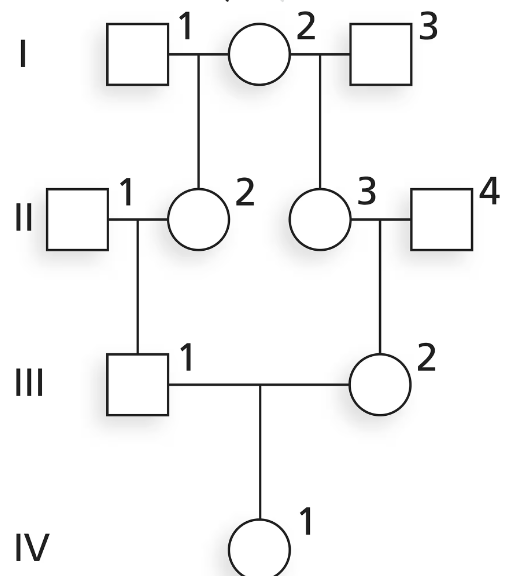
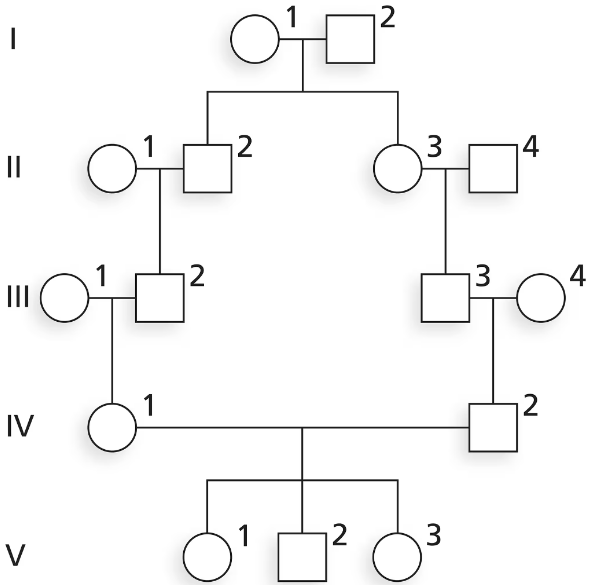
Evaluate the following pedigree, and answer the questions below for individual IV-1. Is IV-1 an inbred individual? If so, who is/are the common ancestor(s)?
Problem 33b
Evaluate the following pedigree, and answer the questions below for individual IV-1. What is F for this individual?
Problem 34a
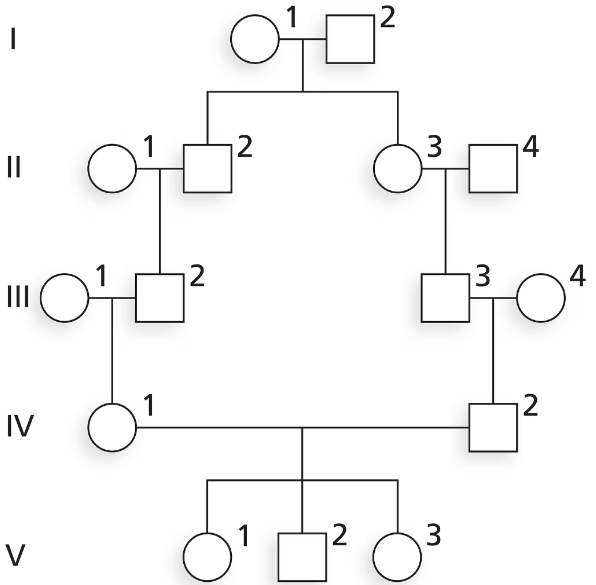
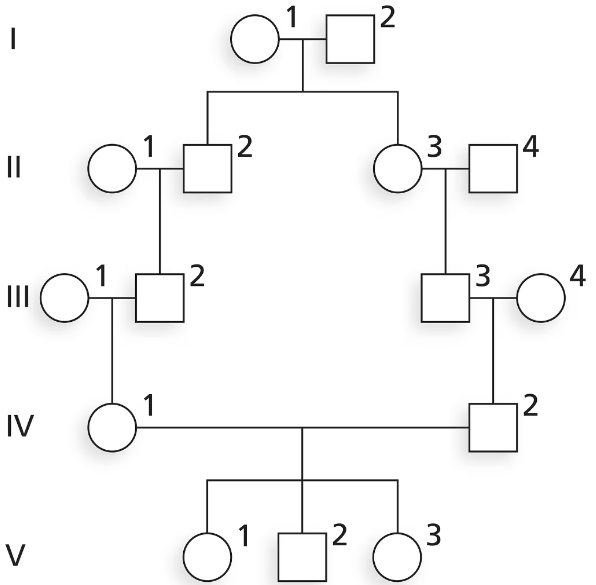
Evaluate the following pedigree, and answer the questions below. Which individual(s) in this family is/are inbred?
Problem 34b
Evaluate the following pedigree, and answer the questions below. Who is/are the common ancestor(s) of the inbred individual(s)?
Problem 34c
Evaluate the following pedigree, and answer the questions below. Calculate F for any inbred members of this family.
Problem 35
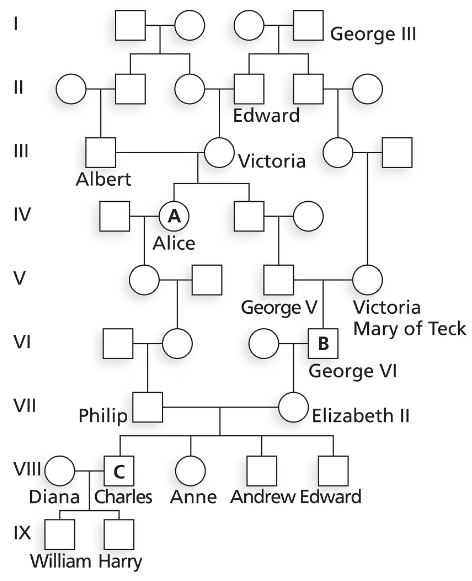
The following is a partial pedigree of the British royal family. The family contains several inbred individuals and a number of inbreeding pathways. Carefully evaluate the pedigree, and identify the pathways and common ancestors that produce inbred individuals A (Alice in generation IV), B (George VI in generation VI), and C (Charles in generation VIII).
Problem 36a
Draw a separate hypothetical pedigree identifying the inbred individuals and the inbreeding pathways for each of the following inbreeding coefficients:
F=4(1/2)⁶
Problem 36b
Draw a separate hypothetical pedigree identifying the inbred individuals and the inbreeding pathways for each of the following inbreeding coefficients:
F=2(1/2)⁵
Problem 36c
Draw a separate hypothetical pedigree identifying the inbred individuals and the inbreeding pathways for each of the following inbreeding coefficients:
F=4(1/2)⁸
Problem 36d
Draw a separate hypothetical pedigree identifying the inbred individuals and the inbreeding pathways for each of the following inbreeding coefficients:
F=2(1/2)⁷
- The human melanocortin 1 receptor gene (MC1R) plays a major role in producing eumelanin, a black-brown pigment that helps determine hair color and skin color. Jonathan Rees and several colleagues (J. L. Rees et al., Am. J. Human Genet. 66(2000): 1351–1361) studied multiple MC1R alleles in African and European populations. Although this research found several MC1R alleles in African populations, MC1R alleles that decrease the production of eumelanin were rare. In contrast, several alleles decreasing eumelanin production were found in European populations. How can these results be explained by natural selection?
Problem 37
- Achromatopsia is a rare autosomal recessive form of complete color blindness that affects about 1 in 20,000 people in most populations. People with this disorder see only in black and white and have extreme sensitivity to light and poor visual acuity. On Pingelap Island, one of a cluster of coral atoll islands in the Federated States of Micronesia, approximately 10% of the 3000 indigenous Pingelapese inhabitants have achromatopsia. Achromatopsia was first recorded on Pingelap in the mid-1800s, about four generations after a typhoon devastated Pingelap and reduced the island population to about 20 people. All Pingelapese with achromatopsia trace their ancestry to one male who was one of the 20 typhoon survivors. Provide a genetic explanation for the origin of achromatopsia on Pingelap, and explain the most likely evolutionary model for the high frequency there of achromatopsia.
Problem 38
Problem 39a
New allopolyploid plant species can arise by hybridization between two species. If hybridization occurs between a diploid plant species with 2n = 14 and a second diploid species with 2n = 22, the new allopolyploid would have 36 chromosomes. Is it likely that sexual reproduction between the allopolyploid species and either of its diploid ancestors would yield fertile progeny? Why or why not?
Problem 39b
New allopolyploid plant species can arise by hybridization between two species. If hybridization occurs between a diploid plant species with 2n = 14 and a second diploid species with 2n = 22, the new allopolyploid would have 36 chromosomes. What type of isolation mechanism is most likely to prevent hybridization between the allopolyploid and the diploid species?
Problem 39c
New allopolyploid plant species can arise by hybridization between two species. If hybridization occurs between a diploid plant species with 2n = 14 and a second diploid species with 2n = 22, the new allopolyploid would have 36 chromosomes. What pattern of speciation is illustrated by the development of the allopolyploid species?