Pearson+ LogoPearson+ Logo
Ch. 20 - Population Genetics and Evolution at the Population, Species, and Molecular Levels
Sanders - Genetic Analysis: An Integrated Approach 3rd Edition
Sanders3rd EditionGenetic Analysis: An Integrated ApproachISBN: 9780135564172Not the one you use?Change textbook
Chapter 20, Problem 13b

Two populations of deer, one of them large and living in a mainland forest and the other small and inhabiting a forest on an island, regularly exchange members that migrate across a land bridge that connects the island to the mainland. An earthquake destroys the bridge between the island and the mainland, making migration impossible for the deer. What do you expect will happen to allele frequencies in the two populations over the following 10 generations?

Verified step by step guidance
1
Understand the concept of gene flow: Gene flow refers to the transfer of alleles or genes from one population to another. In this scenario, the land bridge allowed gene flow between the mainland and island deer populations, maintaining genetic similarity between them.
Consider the impact of isolation: With the destruction of the land bridge, the two populations are now reproductively isolated. This means there will no longer be gene flow between the island and mainland populations, leading to independent evolution of allele frequencies in each population.
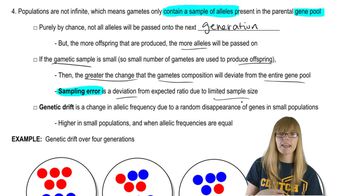
Analyze genetic drift in the island population: The island population is smaller, which makes it more susceptible to genetic drift. Genetic drift is the random fluctuation of allele frequencies due to chance events, and it can lead to significant changes in allele frequencies over generations in small populations.
Evaluate the role of natural selection: Natural selection may act differently on the two populations due to differences in environmental pressures on the island and mainland. Over time, this could lead to divergence in allele frequencies as each population adapts to its specific environment.
Predict long-term outcomes: Over 10 generations, the lack of gene flow, combined with genetic drift and natural selection, is likely to result in genetic divergence between the two populations. The island population may experience more pronounced changes due to its smaller size and potential for stronger environmental pressures.

Verified video answer for a similar problem:

This video solution was recommended by our tutors as helpful for the problem above.
Video duration:
1m
Was this helpful?

Key Concepts

Here are the essential concepts you must grasp in order to answer the question correctly.

Genetic Drift

Genetic drift refers to the random fluctuations in allele frequencies within a population, particularly in small populations. When the land bridge is destroyed, the island population becomes isolated, leading to genetic drift as it can no longer exchange alleles with the mainland population. Over generations, this can result in significant changes in allele frequencies due to chance events, especially in the smaller island population.
Recommended video:
Guided course
10:15
Genetic Drift

Gene Flow

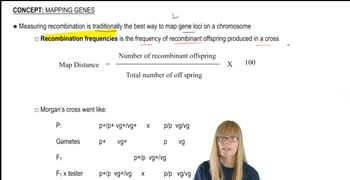
Gene flow is the transfer of genetic material between populations through migration and interbreeding. In this scenario, the destruction of the land bridge halts gene flow between the mainland and island deer populations. This isolation can lead to divergent evolution, as each population adapts to its specific environment without the influence of the other, potentially resulting in distinct genetic traits over time.
Recommended video:
Guided course
09:09
Mapping Genes

Natural Selection

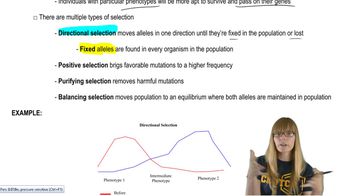
Natural selection is the process by which certain traits become more or less common in a population based on their advantages or disadvantages in a given environment. With the populations now isolated, different selective pressures may act on the mainland and island deer, leading to adaptations that enhance survival and reproduction in their respective habitats. Over generations, this can further differentiate the allele frequencies between the two populations.
Recommended video:
Guided course
05:54
Natural Selection
Related Practice
Textbook Question

When the human genome is examined, the chromosomes appear to have undergone only minimal rearrangement in the 100 million years since the last common ancestor of eutherian mammals. However, when individual humans are examined or when the human genome is compared with that of chimpanzees, a large number of small indels and SNPs can be detected. How are these observations reconciled?

3
views
Textbook Question

Look over the 10 diseases approved for genetic health risk assessment listed in Application Chapter B. Select one disease other than the three discussed in Application Chapter B or in this chapter (alpha-1 antitrypsin deficiency, late-onset Alzheimer disease, and celiac disease) or another of the diseases of your choice. Do a brief Internet search to find and download (1) one article for a nonscientific audience identifying the gene or genes whose alleles are associated with occurrence of the disease and (2) one scientific paper that provides data supporting the association of specific alleles of the gene or genes with the disease. Write a short summary combining the information contained in the two papers.

Textbook Question

Two populations of deer, one of them large and living in a mainland forest and the other small and inhabiting a forest on an island, regularly exchange members that migrate across a land bridge that connects the island to the mainland. If you compared the allele frequencies in the two populations, what would you expect to find?

4
views
Textbook Question

Two populations of deer, one of them large and living in a mainland forest and the other small and inhabiting a forest on an island, regularly exchange members that migrate across a land bridge that connects the island to the mainland. In which population do you expect to see the greatest allele frequency change? Why?

Textbook Question
Directional selection presents an apparent paradox. By favoring one allele and disfavoring others, directional selection can lead to fixation (a frequency of 1.0) of the favored allele, after which there is no genetic variation at the locus, and its evolution stops. Explain why directional selection no longer operates in populations after the favored allele reaches fixation.
Textbook Question

The mtDNA sequence of Neanderthals is more similar to that of modern humans than to that of Denisovans. However, analyses of nuclear DNA clearly indicate that Neandertals and Denisovans share a more recent common ancestor than either of these hominins shares with modern humans. Propose a hypothesis to resolve the discrepancy between the mtDNA and the nuclear genome.

2
views