Pearson+ LogoPearson+ Logo
Ch. 20 - Population Genetics and Evolution at the Population, Species, and Molecular Levels
Sanders - Genetic Analysis: An Integrated Approach 3rd Edition
Sanders3rd EditionGenetic Analysis: An Integrated ApproachISBN: 9780135564172Not the one you use?Change textbook
Chapter 20, Problem D.15

If you were to compare your genome sequence with that of your parents, how would it differ? If you were to compare your genome sequence with another student's in the class, how would it differ? What additional difference might you see if your genome was compared with that of a sub-Saharan African, or if you are of sub-Saharan African descent, with that of a non-African?

Verified step by step guidance
1
Understand that your genome sequence is composed of DNA inherited from both of your parents, so when comparing your genome to either parent's, you will find a high degree of similarity, with differences arising mainly from the unique combination of alleles you inherited and any new mutations that may have occurred.
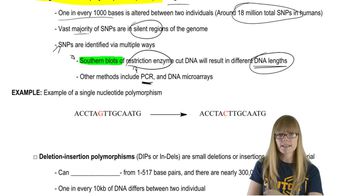
When comparing your genome sequence with another student's in the class, expect to see more differences because each individual has a unique combination of genetic variants, including single nucleotide polymorphisms (SNPs), insertions, deletions, and structural variations, reflecting the genetic diversity within the population.
Recognize that genetic variation tends to be greater between individuals from different populations or geographic regions due to evolutionary history, migration, and genetic drift; therefore, comparing your genome with that of a sub-Saharan African (if you are not of that descent) or vice versa will reveal additional differences, including population-specific alleles and haplotypes.
Consider that sub-Saharan African populations generally have higher genetic diversity compared to non-African populations because modern humans originated in Africa and non-African populations went through bottlenecks during migration out of Africa, which reduced their genetic variation.
Summarize that the differences observed at each comparison level reflect the principles of inheritance, population genetics, and human evolutionary history, which together explain why genomes are more similar within families, less similar within populations, and even more distinct between populations from different continents.

Verified video answer for a similar problem:

This video solution was recommended by our tutors as helpful for the problem above.
Video duration:
3m
Was this helpful?

Key Concepts

Here are the essential concepts you must grasp in order to answer the question correctly.

Genetic Inheritance and Variation

Each individual inherits half of their genome from each parent, resulting in a unique combination of genetic material. While you share about 50% of your DNA with each parent, recombination during meiosis creates new allele combinations, causing differences even between parent and child genomes.
Recommended video:
Guided course
09:28
Genomic Variation

Genetic Diversity Among Individuals

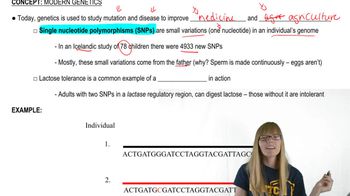
Genomes of unrelated individuals differ due to variations such as single nucleotide polymorphisms (SNPs) and structural variants. These differences accumulate over generations, making each person's genome distinct, even within the same population or classroom.
Recommended video:
Guided course
09:03
Modern Genetics

Population Genetics and Ancestral Differences

Genetic differences between populations, such as sub-Saharan Africans and non-Africans, arise from historical migrations, genetic drift, and natural selection. These lead to population-specific allele frequencies and unique genetic markers that reflect ancestral origins and evolutionary history.
Recommended video:
Guided course
03:45
Descriptive Genetics
Related Practice
Textbook Question
Directional selection presents an apparent paradox. By favoring one allele and disfavoring others, directional selection can lead to fixation (a frequency of 1.0) of the favored allele, after which there is no genetic variation at the locus, and its evolution stops. Explain why directional selection no longer operates in populations after the favored allele reaches fixation.
Textbook Question

The mtDNA sequence of Neanderthals is more similar to that of modern humans than to that of Denisovans. However, analyses of nuclear DNA clearly indicate that Neandertals and Denisovans share a more recent common ancestor than either of these hominins shares with modern humans. Propose a hypothesis to resolve the discrepancy between the mtDNA and the nuclear genome.

2
views
Textbook Question
What is inbreeding depression? Why is inbreeding depression a serious concern for animal biologists involved in species-conservation breeding programs?
Textbook Question

Certain animal species, such as the black-footed ferret, are nearly extinct and currently exist only in captive populations. Other species, such as the panda, are also threatened but exist in the wild thanks to intensive captive breeding programs. What strategies would you suggest in the case of black-footed ferrets and in the case of pandas to monitor and minimize inbreeding depression?

Textbook Question

Genetic Analysis 20.1 predicts the number of individuals expected to have the blood group genotypes MM, MN, and NN. Perform a chi-square analysis using the number of people observed and expected in each blood-type category, and state whether the sample is in H-W equilibrium.

7
views
Textbook Question

In a population of rabbits, f(C₁) = 0.70 and f(C₂) = 0.30. The alleles exhibit an incomplete dominance relationship in which C₁C₁ produces black rabbits, C₁C₂ produces tan-colored rabbits, and C₂C₂ produces rabbits with white fur. If the assumptions of the Hardy–Weinberg principle apply to the rabbit population, what are the expected frequencies of black, tan, and white rabbits?

4
views