Back
Back
Problem 10.RE.3c
Time and Motion In a physics experiment at Doane College, a soccer ball was thrown upward from the bed of a moving truck. The table below lists the time (sec) that has lapsed from the throw and the corresponding height (m) of the soccer ball.
[IMAGE]
c. What horrible mistake would be easy to make if the analysis is conducted without a scatterplot?
Problem 10.RE.3b
Time and Motion In a physics experiment at Doane College, a soccer ball was thrown upward from the bed of a moving truck. The table below lists the time (sec) that has lapsed from the throw and the corresponding height (m) of the soccer ball.
[IMAGE]
b. Based on the result from part (a), what do you conclude about a linear correlation between time and height?
Problem 10.2.33a
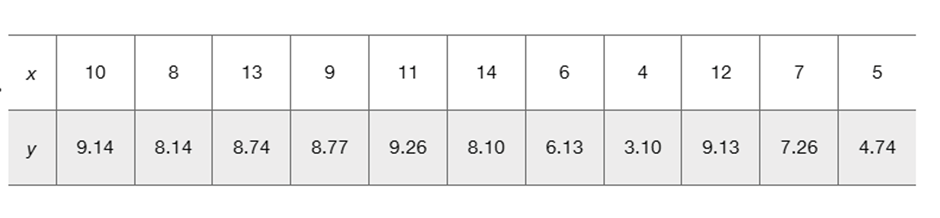
Least-Squares Property According to the least-squares property, the regression line minimizes the sum of the squares of the residuals. Refer to the jackpot/tickets data in Table 10-1 and use the regression equation y^ = -10.9 + 0.174x that was found in Examples 1 and 2 of this section.
a. Identify the nine residuals.
Problem 10.1.3a
Notation The author conducted an experiment in which the height of each student was measured in centimeters and those heights were matched with the same students’ scores on the first statistics test.
a. For this sample of paired data, what does r represent, and what does represent?
Problem 10.2.11a
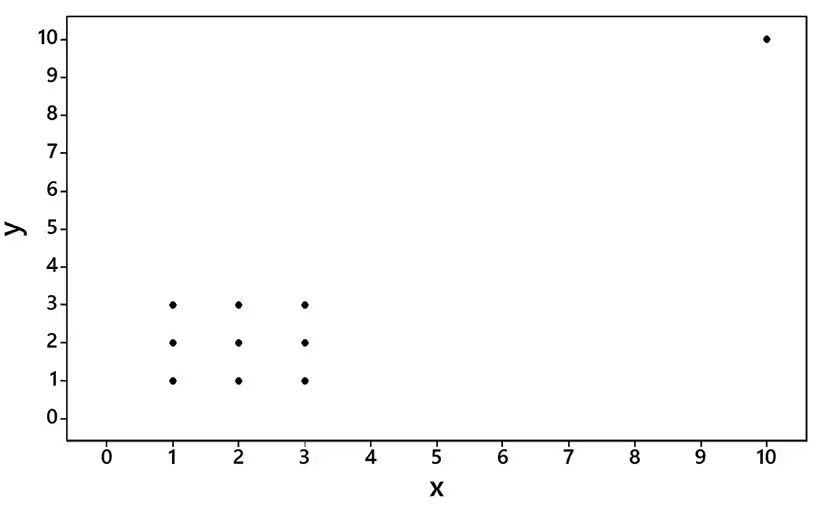
Effects of an Outlier Refer to the Minitab-generated scatterplot given in Exercise 9 of Section 10-1
a. Using the pairs of values for all 10 points, find the equation of the regression line.
Problem 10.2.1a
Notation Using the weights (lb) and highway fuel consumption amounts (mi/gal) of the 48 cars listed in Data Set 35 “Car Data” of Appendix B, we get this regression equation:
y^ = 58.9 - 0.00749x, where x represents weight.
a. What does the symbol y^ represent?
Problem 10.1.11a
Explore!
Exercises 11 and 12 provide two data sets from “Graphs in Statistical Analysis,” by F. J. Anscombe, the American Statistician, Vol. 27. For each exercise,
a. Construct a scatterplot.
Problem 10.2.12a
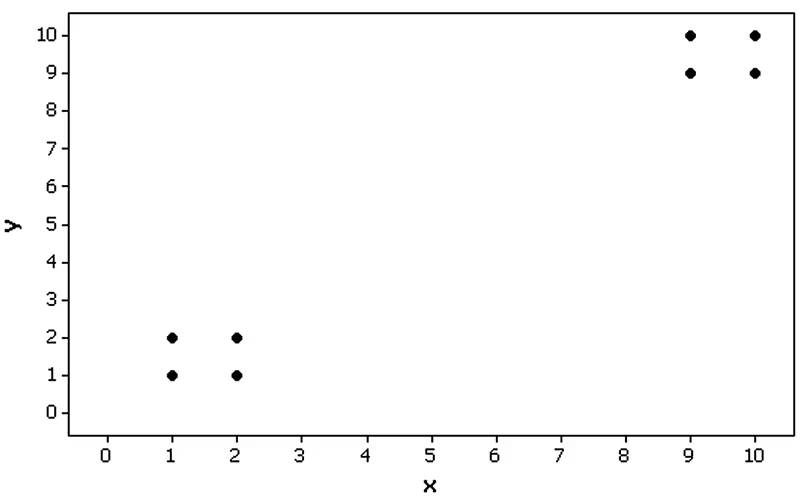
Effects of Clusters Refer to the Minitab-generated scatterplot given in Exercise 10 of Section 10-1.
a. Using the pairs of values for all 8 points, find the equation of the regression line.
Problem 10.1.10a
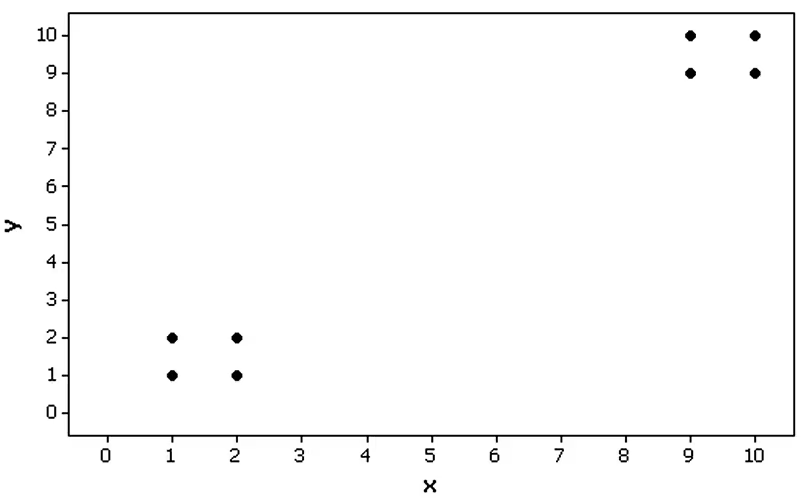
Clusters Refer to the Minitab-generated scatterplot. The four points in the lower left corner are measurements from women, and the four points in the upper right corner are from men.
a. Examine the pattern of the four points in the lower left corner (from women) only, and subjectively determine whether there appears to be a correlation between x and y for women.
Problem 10.3.17a
Variation and Prediction Intervals
In Exercises 17–20, find the (a) explained variation, (b) unexplained variation, and (c) indicated prediction interval. In each case, there is sufficient evidence to support a claim of a linear correlation, so it is reasonable to use the regression equation when making predictions.
Altitude and Temperature Listed below are altitudes (thousands of feet) and outside air temperatures (°F) recorded by the author during Delta Flight 1053 from New Orleans to Atlanta. For the prediction interval, use a 95% confidence level with the altitude of 6327 ft (or 6.327 thousand feet).
Problem 10.1.1b
Notation The author conducted an experiment in which the height of each student was measured in centimeters and those heights were matched with the same students’ scores on the first statistics test.
b. Without doing any research or calculations, estimate the value of r.
Problem 10.1.9b
Outlier Refer to the accompanying Minitab-generated scatterplot.
b. After identifying the 10 pairs of coordinates corresponding to the 10 points, find the value of the correlation coefficient r and determine whether there is a linear correlation.
Problem 10.2.33b
Least-Squares Property According to the least-squares property, the regression line minimizes the sum of the squares of the residuals. Refer to the jackpot/tickets data in Table 10-1 and use the regression equation y^ = -10.9 + 0.174x that was found in Examples 1 and 2 of this section.
b. Find the sum of the squares of the residuals.
Problem 10.1.1c
Notation The author conducted an experiment in which the height of each student was measured in centimeters and those heights were matched with the same students’ scores on the first statistics test.
c. Does r change if the heights are converted from centimeters to inches?
Problem 10.5.18c
Sum of Squares Criterion In addition to the value of another measurement used to assess the quality of a model is the sum of squares of the residuals. Recall from Section 10-2 that a residual is (the difference between an observed y value and the value predicted from the model). Better models have smaller sums of squares. Refer to the U.S. population data in Table 10-7.
c. Verify that according to the sum of squares criterion, the quadratic model is better than the linear model.
Problem 10.2.1c
Notation Using the weights (lb) and highway fuel consumption amounts (mi/gal) of the 48 cars listed in Data Set 35 “Car Data” of Appendix B, we get this regression equation:
y^ = 58.9 - 0.00749x, where x represents weight.
c. What is the predictor variable?
Problem 10.1.10d
Clusters Refer to the Minitab-generated scatterplot. The four points in the lower left corner are measurements from women, and the four points in the upper right corner are from men.
Find the value of the linear correlation coefficient using all eight points. What does that value suggest about the relationship between x and y?
Problem 10.q.9
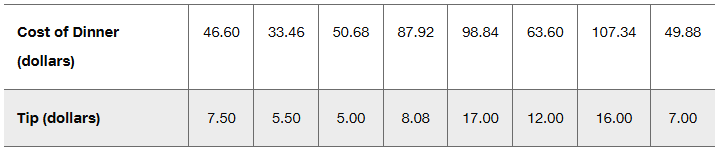
Exercises 1–10 are based on the following sample data consisting of costs of dinner (dollars) and the amounts of tips (dollars) left by diners. The data were collected by students of the author.
Predictions Repeat the preceding exercise assuming that the linear correlation coefficient is r = 0.132.
Problem 12.CR.2
Comparing Two Means Treating the data as samples from larger populations, test the claim that there is a significant difference between the mean of presidents and the mean of popes.
Problem 13
Testing for a Linear Correlation
In Exercises 13–28, construct a scatterplot, and find the value of the linear correlation coefficient r. Also find the P-value or the critical values of r from Table A-6. Use a significance level of α = 0.05. Determine whether there is sufficient evidence to support a claim of a linear correlation between the two variables. (Save your work because the same data sets will be used in Section 10-2 exercises.)
Powerball Jackpots and Tickets Sold Listed below are the same data from Table 10-1 in the Chapter Problem, but an additional pair of values has been added in the last column. Is there sufficient evidence to conclude that there is a linear correlation between lottery jackpot amounts and numbers of tickets sold? Comment on the effect of the added pair of values in the last column. Compare the results to those obtained in Example 4.
[IMAGE]