Pearson+ LogoPearson+ Logo
Ch.14 Carboxylic Acids, Esters, Amines, and Amides
Timberlake - Chemistry: An Introduction to General, Organic, and Biological Chemistry 14th Edition
Timberlake14thChemistry: An Introduction to General, Organic, and Biological ChemistryISBN: 9781292472249Not the one you use?Change textbook
Chapter 14, Problem 72

Draw the condensed structural formulas for the products of the reaction of aspartate and α-ketoglutarate which is catalyzed by aspartate transaminase (AST).

Verified step by step guidance
1
Understand the reaction: Aspartate transaminase (AST) catalyzes a transamination reaction where an amino group is transferred from aspartate to α-ketoglutarate, forming oxaloacetate and glutamate as products.
Identify the reactants: Aspartate is an amino acid with the structure NH₂-CH(COOH)-CH₂-COOH, and α-ketoglutarate is a keto acid with the structure CO-CH₂-CH₂-COOH.
Determine the products: In the reaction, the amino group from aspartate is transferred to α-ketoglutarate, converting aspartate into oxaloacetate (CO-CH₂-COOH) and α-ketoglutarate into glutamate (NH₂-CH(COOH)-CH₂-CH₂-COOH).
Draw the condensed structural formula for oxaloacetate: Oxaloacetate is a keto acid with the structure CO-CH₂-COOH. Represent this in condensed form as CH₂(CO)-COOH.
Draw the condensed structural formula for glutamate: Glutamate is an amino acid with the structure NH₂-CH(COOH)-CH₂-CH₂-COOH. Represent this in condensed form as NH₂-CH(COOH)-CH₂-CH₂-COOH.

Verified video answer for a similar problem:

This video solution was recommended by our tutors as helpful for the problem above.
Video duration:
5m
Was this helpful?

Key Concepts

Here are the essential concepts you must grasp in order to answer the question correctly.

Transamination

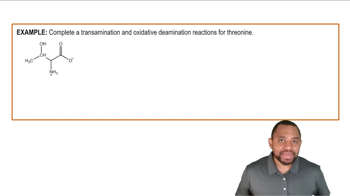
Transamination is a biochemical process where an amino group from an amino acid is transferred to a keto acid, forming a new amino acid and a new keto acid. This reaction is crucial in amino acid metabolism and is catalyzed by enzymes known as transaminases or aminotransferases. In the context of the question, aspartate transaminase (AST) facilitates the conversion of aspartate and α-ketoglutarate.
Recommended video:
Guided course
3:03
Amino Acid Catabolism: Amino Group Example 2

Aspartate

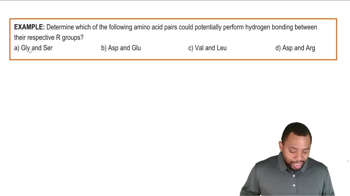
Aspartate is a non-essential amino acid that plays a key role in the urea cycle and in the synthesis of other amino acids. It contains an amino group, a carboxyl group, and a side chain that contributes to its properties. In the transamination reaction, aspartate donates its amino group to α-ketoglutarate, resulting in the formation of oxaloacetate.
Recommended video:
Guided course
2:00
Secondary Protein Structure Example 1

α-Ketoglutarate

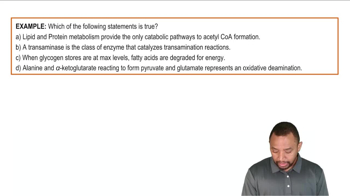
α-Ketoglutarate is a key intermediate in the Krebs cycle (citric acid cycle) and serves as a keto acid in transamination reactions. It is formed from the deamination of glutamate and can accept an amino group to form glutamate. In the reaction with aspartate, α-ketoglutarate is converted into glutamate, illustrating the interconnectedness of amino acid metabolism and energy production.
Recommended video:
Guided course
1:33
Review of Metabolism Example 1