Pearson+ LogoPearson+ Logo
Ch.14 Carboxylic Acids, Esters, Amines, and Amides
Timberlake - Chemistry: An Introduction to General, Organic, and Biological Chemistry 14th Edition
Timberlake14thChemistry: An Introduction to General, Organic, and Biological ChemistryISBN: 9781292472249Not the one you use?Change textbook
Chapter 14, Problem 68d

Draw the condensed structural or line-angle formula if cyclic, for each of the following:
d. ethylmethylammonium bromide

Verified step by step guidance
1
Step 1: Understand the compound name 'ethylmethylammonium bromide'. It consists of an ammonium ion (a positively charged nitrogen atom bonded to four groups) and a bromide ion (Br⁻). The ammonium ion has an ethyl group (-CH₂CH₃) and a methyl group (-CH₃) attached to the nitrogen.
Step 2: Begin by drawing the ammonium ion. Place the nitrogen atom (N) at the center. Attach the ethyl group (-CH₂CH₃) and the methyl group (-CH₃) to the nitrogen. Additionally, add two hydrogen atoms to complete the four bonds around the nitrogen.
Step 3: Represent the positive charge on the nitrogen atom. Since nitrogen typically forms three bonds, the fourth bond (to the hydrogen) gives it a formal positive charge, making it an ammonium ion.
Step 4: Add the bromide ion (Br⁻) to the structure. This is the counterion to balance the positive charge on the ammonium ion. The bromide ion is not covalently bonded to the ammonium ion but is associated electrostatically.
Step 5: Write the condensed structural formula for the compound. Combine the ammonium ion and bromide ion into a single representation. For example, the condensed formula for the ammonium ion could be written as [CH₃CH₂NH₃⁺], and the bromide ion is simply Br⁻. Together, the compound is represented as [CH₃CH₂NH₃⁺]Br⁻.

Verified video answer for a similar problem:

This video solution was recommended by our tutors as helpful for the problem above.
Video duration:
4m
Was this helpful?

Key Concepts

Here are the essential concepts you must grasp in order to answer the question correctly.

Condensed Structural Formula

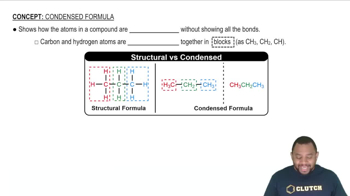
A condensed structural formula is a way of representing a chemical compound that shows the arrangement of atoms and the connectivity between them without depicting all the bonds explicitly. It simplifies the structure by grouping atoms together, often indicating functional groups and the overall molecular framework. For example, in ethylmethylammonium bromide, the formula would highlight the ethyl and methyl groups attached to the ammonium ion.
Recommended video:
Guided course
1:53
Condensed Formula Concept 1

Line-Angle Formula

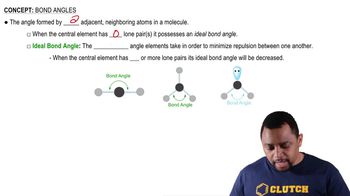
The line-angle formula, also known as the skeletal formula, is a shorthand representation of organic molecules where vertices represent carbon atoms and lines represent bonds. This method omits hydrogen atoms attached to carbons, making it easier to visualize complex structures. For cyclic compounds, the line-angle formula can effectively illustrate the ring structure and branching in a compact form.
Recommended video:
Guided course
01:24
Bond Angles (Simplified) Concept 1

Cyclic Compounds

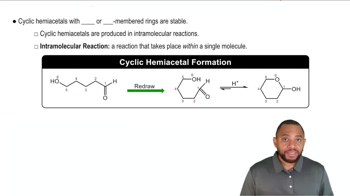
Cyclic compounds are organic molecules that contain a ring structure formed by the bonding of carbon atoms. These compounds can be saturated or unsaturated and may include various functional groups. Understanding cyclic compounds is essential for drawing their structural representations, as the ring affects the overall geometry and reactivity of the molecule, as seen in the case of ethylmethylammonium bromide.
Recommended video:
Guided course
2:55
Cyclic Hemiacetals Concept 2